Mantras and their meanings.
The tools of yoga that work through sound. Sanskrit verses, transliteration, plain-language meaning, and PDFs you can take home.
Mantras are sacred words, phrases or sounds chanted or recited repeatedly as part of the spiritual practices of Hinduism, Buddhism and the wider Indian traditions. The word mantra comes from Sanskrit: man, to think, and tra, tool or instrument. A mantra is a tool for focusing and steadying the mind, and for connecting with higher consciousness or divine energies.
Our ashram's core chants.
Two complete prayer sets we recite every day at Bodhidham. Read the full text, hear the meaning, and download the PDF to chant at home.
 Sanskrit · transliteration · PDF
Ashtanga opening & closing chants.
Guru Dhyanam, Patanjali Vandana and the Mangala Mantra. The traditional opening and closing prayers of the Mysore Ashtanga lineage, chanted at every practice.
Read the prayer →Sanskrit · word meaning · PDFBodhidham opening & closing prayer.
The starting and closing prayer of Bodhidham Yog Dhyan Ashram. A salutation to the Guru, and the Pavamana Mantra asking to be led from darkness to light.
Read the prayer →Powerful mantras of the tradition.
A short field guide to the most widely chanted mantras of the Hindu tradition. Each is used for a different purpose: protection, healing, devotion, awakening.
Durga Saptasati
Seven verses from the Durga Saptasati. Chanted to remove obstacles and clear negativity, traditionally during the festival of Navaratri.
Maha Mritunjaya
The mantra of healing. Heals illness and disease, and is said to prevent untimely death. Addressed to Lord Shiva.
Peace Mantra
Connects master and disciple to progress together on the path of enlightenment. Recited at the start of a teaching.
Shanti Mantra
Recited for inner peace, for steadying the nervous system, and for receiving positive energy. Meaning: Lead me from the unreal to the Real. Lead me from darkness to Light. Lead me from death to Immortality. Om peace, peace, peace.
Om
The most basic and widely used mantra. Represents the sound of the universe and the ultimate reality. Meaning: Om is the primordial sound — the vibration from which all creation emerges and into which it dissolves. It encompasses the three states of consciousness: A (waking), U (dreaming), M (deep sleep), and the silence after — Turiya (transcendental consciousness).
Gayatri Mantra
A prayer to the Sun god for wisdom, enlightenment and liberation. One of the oldest Vedic mantras. Meaning: We meditate on the glory of the Creator who has created the Universe, who is worthy of worship, who is the embodiment of knowledge and light, who is the remover of all sins and ignorance. May He enlighten our intellect.
Hanuman Chalisa
A hymn to Lord Hanuman, the symbol of strength, courage and devotion. Forty verses recited as one prayer.
Hare Krishna Maha Mantra
A chant to Lord Krishna for love, joy and spiritual bliss. Sixteen names of the divine repeated in a single round.
Words of protection.
In the Buddhist traditions mantras are called dharanis. They are recited to purify the mind, cultivate compassion and wisdom, and generate positive karma. Often tied to a specific bodhisattva or Buddha.
Om Mani Padme Hum
Associated with the bodhisattva of compassion, Avalokiteshvara. Literally jewel in the lotus. Meaning: Om is the primordial sound — the vibration from which all creation emerges and into which it dissolves. It encompasses the three states of consciousness: A (waking), U (dreaming), M (deep sleep), and the silence after — Turiya (transcendental consciousness).
Namo Amituofo
Homage to Amitabha Buddha. Used to invoke his blessing and guidance on the path.
Tadyatha Om Gate Gate Paragate Parasamgate Bodhi Svaha
From the Heart Sutra. Gone, gone, gone beyond, gone altogether beyond, O what an awakening. Meaning: Om is the primordial sound — the vibration from which all creation emerges and into which it dissolves. It encompasses the three states of consciousness: A (waking), U (dreaming), M (deep sleep), and the silence after — Turiya (transcendental consciousness).
Hear the mantras at dawn.
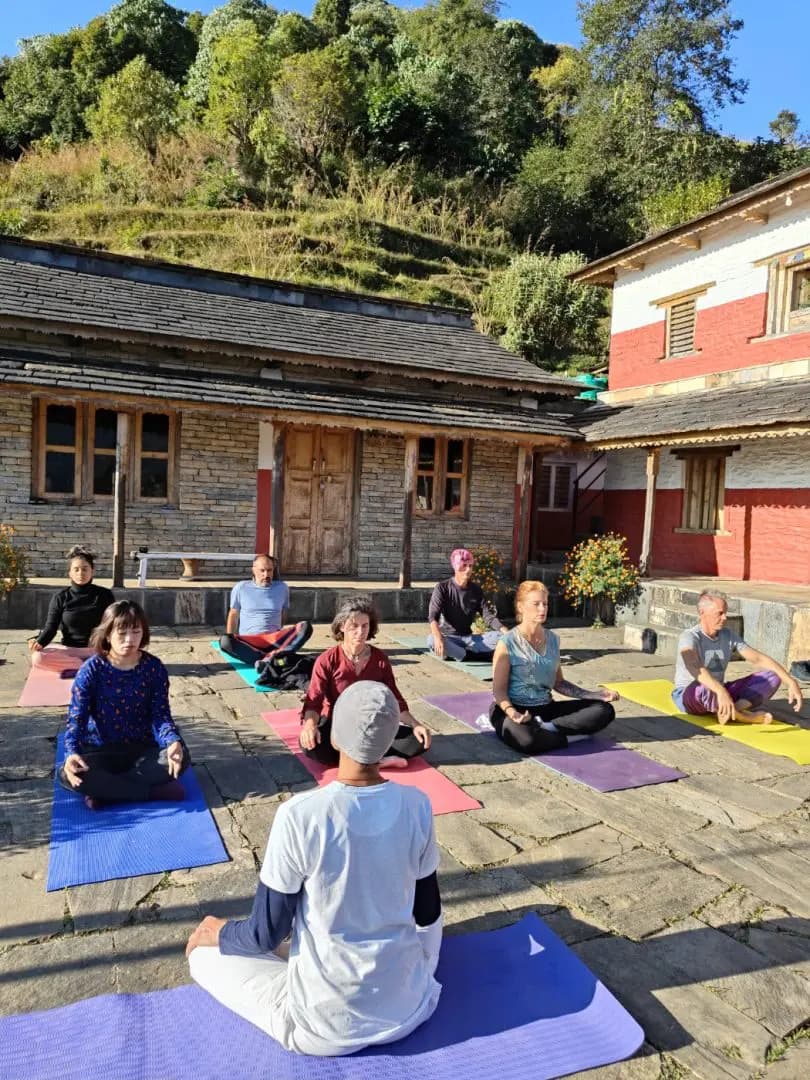
Every retreat and training at Bodhidham begins and ends with chanting. If reading the words is the first step, hearing them in a shala at sunrise is the second.