Note: “ Pranayama should always be practised under the guidance of a competent teacher. It is a subtle practice, one that works directly with the breath and, through it, with the deeper rhythms of the body and mind. When not done correctly, this same practice that calms and balances can just as easily produce the opposite effect, leaving you unsettled rather than at ease. Approach it with patience, and let a qualified teacher guide you as you go.”
In all my years of teaching here at the ashram, I have come to believe that the breath is the simplest and most powerful tool a person has. We breathe all day without thinking about it, yet when we learn to breathe with awareness, the mind grows calm, the body settles, and the whole of yoga opens up. This is the practice we call pranayama.
Many people think pranayama is difficult or only for advanced yogis. It is not. You can begin today, at home, with nothing but a quiet corner and a few minutes.
I will share the five breathing techniques I start every beginner with, exactly as I teach them, along with the simple rules that keep your practice safe. You can also follow these and other guided practices in our free yoga resources library.
What is Pranayama really?
The word pranayama is made of two parts. “Prana” is the life force, the energy that flows through us and keeps us alive. “Ayama” means to extend or to guide. So pranayama is the practice of guiding your life force through the breath, which is its most visible form.
In yoga, we say this energy travels through fine channels in the body called nadis. When the breath is rushed and shallow, the energy is scattered, and the mind is restless. When the breath becomes slow, smooth, and steady, the energy settles, and the mind grows quiet.
That is the whole secret of pranayama, and it is why it sits as the fourth of the eight limbs of yoga, the bridge between the body and the deeper practice of meditation.
Before you begin: a few simple rules
A little care at the start saves you trouble later. These are the same things you should consider.
- Practise on an empty stomach. Early in the morning is best, before you eat. If you have had a full meal, wait three to four hours. After water, fifteen minutes is enough. A full belly makes the breath heavy and the mind dull.
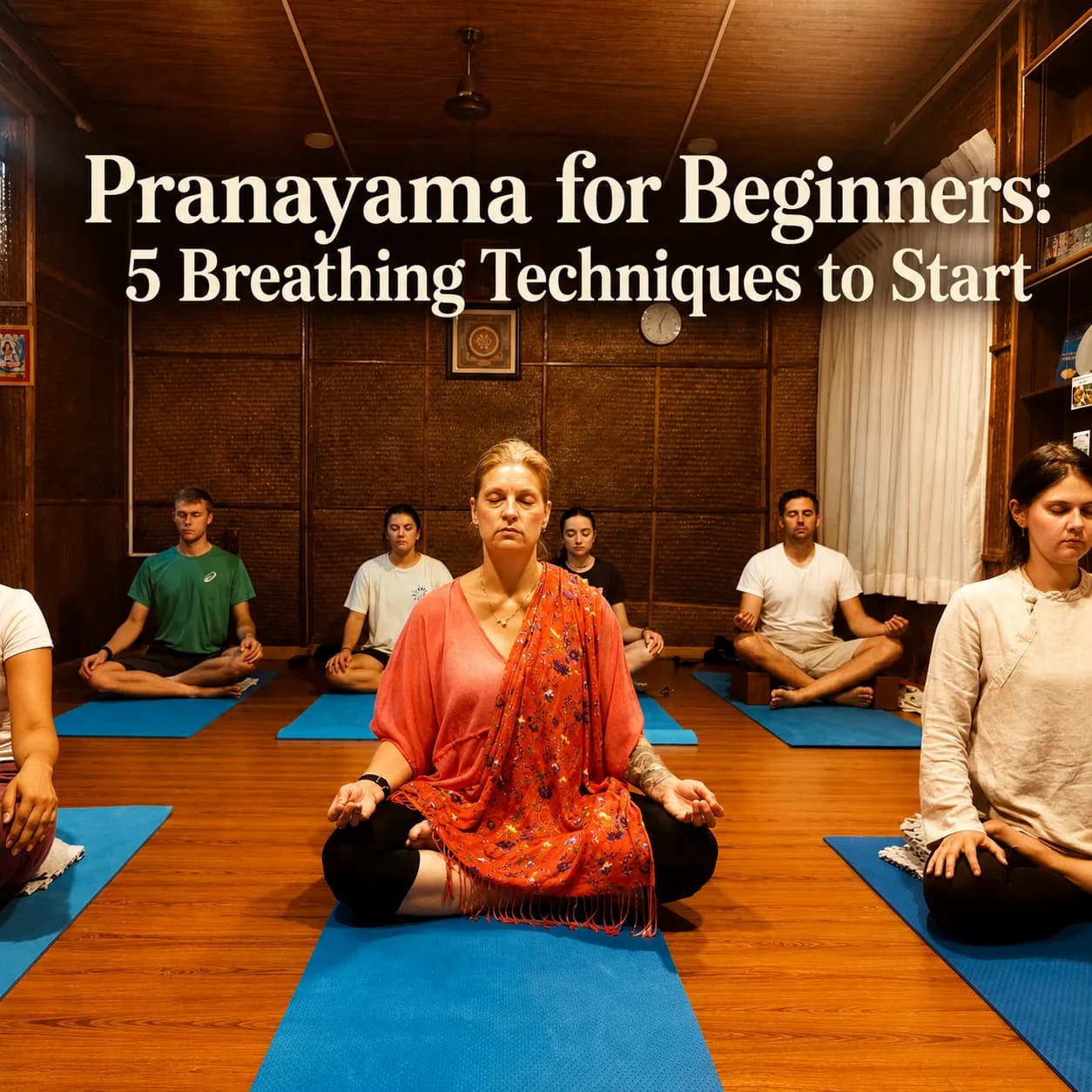
- Sit with a straight spine. Sit cross-legged on the floor or upright on a chair, tall but relaxed. A straight spine lets the breath move freely.
- Breathe through the nose. Unless a practice says otherwise, both the in-breath and the out-breath go through the nose.
- Never force the breath. This is the most important rule. Pranayama is gentle. If you feel dizzy or strained, stop and breathe normally for a minute. More effort does not mean more progress.
- Start small. Five to ten minutes a day is plenty at the beginning. It is far better to practise a little every day than a lot once in a while.
The five breathing techniques to start with
I teach these in this order because each one prepares you for the next. Take your time with each before moving on.
1. Deep belly breathing (the foundation)
Most students breathe shallowly, high in the chest. Before anything else, you must learn to breathe fully and low, into the belly. Every other practice rests on this one.
How to do it:
1. Sit or lie down comfortably. Rest one hand on your belly and one on your chest.
2. Breathe in slowly through the nose and let your belly rise gently under your hand. The chest stays almost still.
3. Breathe out slowly and let the belly fall.
4. Keep it smooth and quiet. Continue for five to ten minutes.
This calms the mind, opens the lungs, and corrects the shallow breathing that causes most of the dizziness beginners feel in other practices. Do not rush past it. When deep belly breathing feels natural, you are ready for the rest.
2. Equal breathing (Sama Vritti)
Once your breath is low and full, the next step is to make it even. In equal breathing, the in-breath and the out-breath are the same length. This is a simple and very calming way to bring control and steadiness to the mind.
How to do it:
1. Breathing through the nose, breathe in for a slow count of four.
2. Breathe out for the same slow count of four.
3. Keep both halves smooth and equal, with no pause and no strain.
4. When four feels easy, you can lengthen to five or six, but only if it stays comfortable.
This is wonderful before meditation or whenever the mind feels scattered, because counting gives the mind a gentle, simple thing to hold.
3. Ocean breath (Ujjayi)
Ujjayi is a soft, ocean-like sound you make by gently narrowing the back of the throat. It slows the breath naturally and gives the mind a sound to rest on.
How to do it:
1. Breathe in and out through the nose.
2. Gently tighten the very back of your throat, as if you were going to fog a mirror but with your mouth closed.
3. This makes a soft hissing or ocean sound on both the in-breath and the out-breath.
4. Keep the sound quiet and the throat relaxed. Practise for a few minutes.
This is the breath we use during moving yoga practice, and on its own, it is calming and steadying. Keep it soft. If the throat feels strained, you are trying too hard.
4. Alternate nostril breathing (Nadi Shodhana)
This is one of the most balancing practices in all of yoga, and one of my favourites to teach. By breathing through one nostril at a time, you bring the two sides of the body and mind into balance.
How to do it:
1. Sit tall. Use your right thumb to close your right nostril and your right ring finger to close your left nostril.
2. Close the right nostril and breathe in slowly through the left.
3. Close the left nostril, open the right, and breathe out through the right.
4. Breathe in through the right.
5. Close the right, open the left, and breathe out through the left. That is one full round.
6. Keep the breath slow and smooth. Do five to ten rounds.
This calms the nervous system and clears the mind. It is beautiful first thing in the morning, or in the evening, to let go of the day before you sit to meditate.
5. Bee breath (Bhramari)
Bhramari is named after the humming of a bee, and it is the quickest way I know to calm a troubled mind. The gentle vibration of the humming soothes the whole nervous system.
How to do it:
1. Sit tall and take a slow breath in through the nose.
2. As you breathe out, keep your lips softly closed and make a steady, gentle humming sound, like a bee.
3. Feel the soft vibration in your head and face.
4. Breathe in again, and repeat for five to ten rounds.
If you want to go deeper, you can softly close your ears with your thumbs while you hum. This is the practice I recommend most for anxiety, anger, and trouble sleeping. A few rounds at bedtime can change your whole night.
A simple routine to begin with
You do not need to do all five every day. Here is a gentle ten-minute routine I give to beginners:
1. Deep belly breathing, three minutes, to settle in.
2. Alternate nostril breathing, four minutes, to balance and calm.
3. Bee breath, three minutes, to quiet the mind.
Sit quietly for a moment at the end and simply notice how you feel. Do this each morning, and within a couple of weeks, you will feel the difference in your calm, your focus, and your sleep.
Common mistakes to avoid
Over the years, I have watched the same few mistakes again and again. Avoid these, and your practice will be safe and steady.
- Trying too hard. Forcing your breath or holding a long breath strains the lungs and heart and can make you dizzy. Gentleness is the path.
- Breathing too fast. Beginners often rush, which leads to light-headedness. Slow down.
- Holding the breath too long, too soon. Breath-holding is an advanced step. Leave it for later, under a teacher.
- Breathing into the chest instead of the belly. This is the usual cause of dizziness. If you feel light-headed, return to deep belly breathing.
- Doing too much, too soon. Do not learn five strong practices in one day from a video and pile them on. Build slowly, one at a time.
You may have heard of Kapalabhati (skull-shining breath) and Bhastrika (bellows breath). These are forceful cleansing practices, and they are powerful. But they are not where a beginner should start, and they are not suitable for everyone. If you are pregnant, have high blood pressure or a heart condition, or have had recent surgery, you should avoid them. Learn these later, slowly, with a teacher who can watch over you. The five gentle practices above will serve you well for a long time first.
Bringing the breath into your day
The real gift of pranayama is that it follows you off the mat. Once you know these practices, you can take a few slow belly breaths in a stressful moment, or hum a few rounds of bee breath before sleep, and steady yourself anywhere. The breath is always with you. Learning to use it well is one of the kindest things you can do for yourself.
If this practice draws you in and you wish to learn it properly, with the deeper techniques taught safely and in person, that is the heart of what we offer in our yoga teacher training. But you do not need to wait for that. Sit down tomorrow morning, breathe gently into your belly, and you have already begun.
Frequently asked questions
- What is the best time to do pranayama?
Early in the morning, on an empty stomach, is the traditional and the best time. The mind is fresh and quiet, and the breath comes easily. The evening, before you sit to meditate, is also good. The most important thing is to practise at the same time each day, so it becomes a steady habit.
2. Can I do pranayama on a full stomach?
It is best not to. A full belly makes the breath heavy and pulls your energy toward digestion. Wait about three to four hours after a full meal, an hour or so after something light, and around fifteen minutes after drinking water. Practising on an empty stomach keeps the mind clear and the breath light.
3. How long should a beginner practise each day?
Begin with just five to ten minutes a day. This is enough to feel the benefits without strain. As the practice becomes comfortable over the weeks, you can slowly grow it to fifteen or twenty minutes. A little every day does far more than a long session now and then.
4. Which pranayama is best for stress and anxiety?
Bee breath (Bhramari) and alternate nostril breathing (Nadi Shodhana) are the two I recommend most for a busy or anxious mind. The humming of bee breath calms the nervous system quickly, and alternate nostril breathing brings a deep sense of balance. Even a few minutes of either can settle you.
5. Can pranayama be done wrong, and who should be careful?
The gentle practices in this guide are safe for almost everyone when done without force. The main thing is never to strain or hold the breath beyond comfort. The forceful practices, like Kapalabhati and Bhastrika, do need care and should be avoided if you are pregnant or have high blood pressure, a heart condition, or recent surgery. If you have any health concerns, check with your doctor and learn from a teacher.
6. Do I need to do all five techniques every day?
No. It is better to keep it simple. Pick two or three, such as belly breathing, alternate nostril breathing, and bee breath, and practise those each day. You can change them as you grow. Steadiness matters far more than variety.