Long before modern anatomy named its nerve plexuses and endocrine glands, the yogis of ancient India had already drawn an inner map. They called it the subtle body, and at the centre of that map were seven energy wheels, turning along the spine from the base of the pelvis to the crown of the skull. They called them “chakras”.
That map has moved, in the last fifty years, from the manuscripts of Tantric scholars into yoga studios and wellness products the world over, and along the way it has changed considerably. This guide goes back to what the old texts actually say, explains each of the seven chakras as the tradition understood them, and gives you practical tools, drawn from yoga and meditation, for working with this system in real practice.
What a chakra actually is
The word chakra (Sanskrit: cakra) means wheel or circle. In the classical tradition, chakras are not physical organs you can see in a body. They are centres of energy in the subtle body, which the tradition calls the sukshma sharira. The subtle body is the energetic dimension of the person, the layer that holds consciousness, breath, emotion, and awareness, underneath and interpenetrating the physical.
The chakras sit along the central channel of this subtle body, the sushumna nadi, which runs from the base of the spine to the crown of the head. Running alongside it on either side are two more channels: ida, associated with the left side, the moon, and receptive qualities, and pingala, associated with the right side, the sun, and active qualities. These three channels, and the seven centres along their axis, are the architecture the old teachers worked with.
Where this teaching comes from
The most detailed classical account of the chakra system is the Sat Chakra Nirupana, composed by Purnananda in 1577. It is a Tantric text of 56 verses that describes each chakra with careful precision: its location, its lotus petals, its presiding deities, its bija mantra, its element, and its psychological qualities. The system also appears in the Shiva Samhita and the Gorakshashatakam, though with some variation in detail.
The Hatha Yoga tradition, from which most modern yoga descends, inherited the chakra model and placed it at the centre of its understanding of why posture, breath control, and energy lock practices (bandha) work. The logic was this: the ordinary person's energy is dispersed. Yoga practice gathers and refines it, making it available to rise through the sushumna, awakening each centre in turn.
Muladhara: the root chakra
Sanskrit meaning: Root support (mula = root, adhara = support or base)
Location: Base of the spine, at the perineum
Element: Earth (prithvi)
Seed mantra: LAM
Lotus petals: 4
Colour: Deep red
Muladhara is the foundation of the whole system. It sits at the lowest point of the spine, at the meeting place of the body and the earth, and it governs everything connected to survival, stability, and belonging. The four petals carry the four psychic states associated with this centre: joy, pleasure, passion, and delight, but in their disturbed or unintegrated forms.
In the body, Muladhara relates to the legs and feet, the bones, the adrenal glands, and the large intestine. The earth element here is literal: this chakra is about being grounded, being in the body, feeling safe enough to exist. A person whose Muladhara is well integrated feels physically rooted, financially and emotionally secure, and at home in their own skin.
When this centre is unsettled, the signs show up as chronic anxiety and fear, a constant sense of threat even in safe environments, difficulty feeling present in the body, restlessness, or a deep sense of not belonging anywhere. The body tightens at the base, the legs feel unsteady, and the nervous system stays on alert.
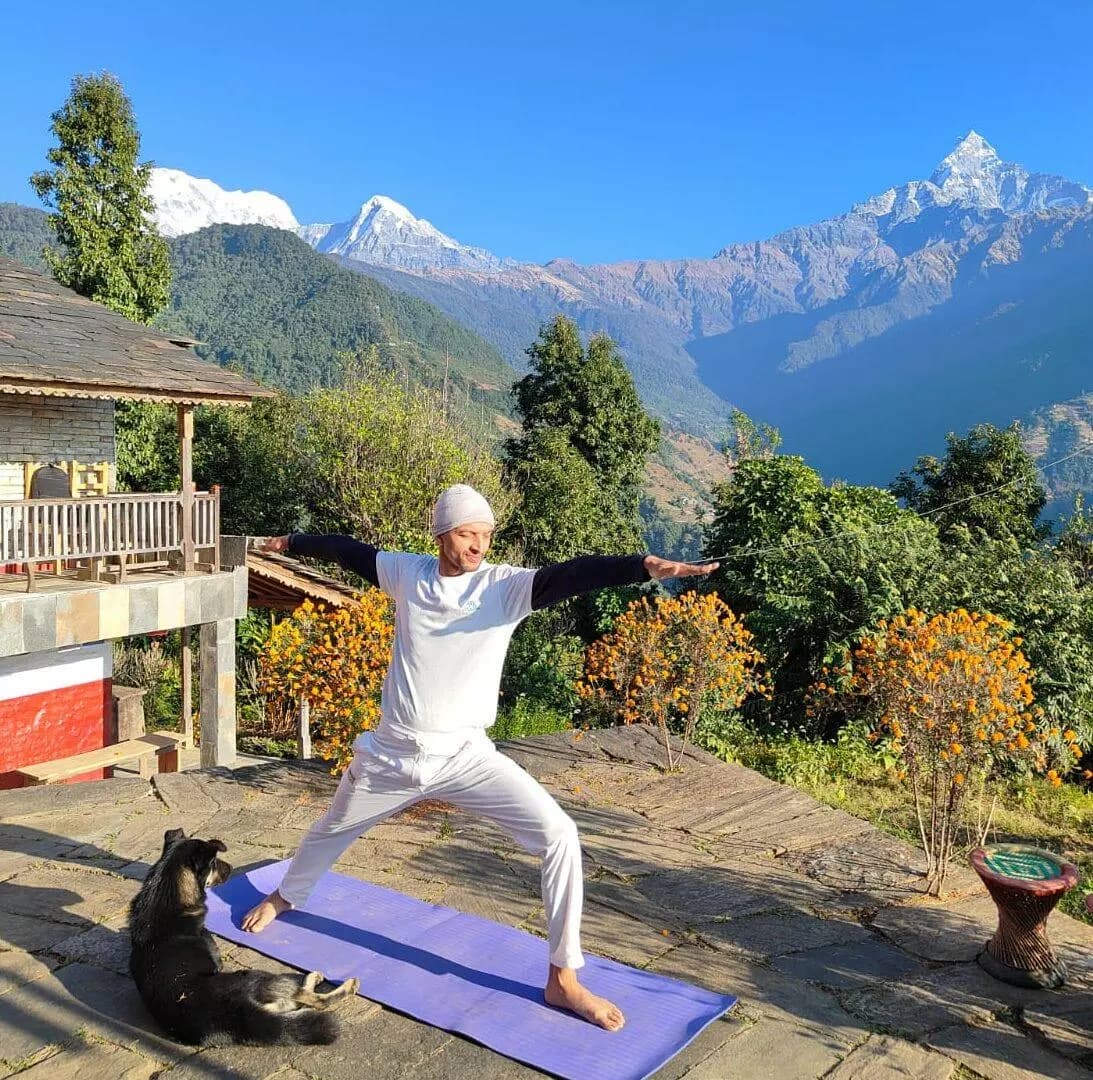
In yoga practice: Standing poses are the primary tool here, poses where the feet press into the ground and the legs form a strong base: Tadasana (Mountain), Virabhadrasana I and II (Warrior I and II), Vrksasana (Tree). The practice is not vigorous movement so much as active stillness, learning to feel the contact between body and earth.
Svadhisthana: the sacral chakra
Sanskrit meaning: One's own dwelling place (sva = one's own, adhisthana = dwelling or abode)
Location: Just below the navel, at the sacrum
Element: Water (apas)
Seed mantra: VAM
Lotus petals: 6
Colour: Orange
Svadhisthana is the centre of flow: emotion, creativity, sexuality, and pleasure. The water element captures its quality exactly. Water moves, adapts, finds its own level, and nourishes everything it touches. So does a healthy Svadhisthana. The six petals carry qualities including affection, pitilessness, feeling of destruction, delusion, disdain, and suspicion, the whole range of emotional reactivity that needs to be worked through at this level.
In the body, this chakra relates to the reproductive organs, the kidneys and bladder, and the hips and lower back. It is the centre where sensation becomes feeling and where feeling generates the creative impulse. The tradition places a great deal of importance here because this is where life force (prana) most readily transforms into either creative energy or reactive emotion.
In yoga practice: Hip-opening poses and fluid movement are the tools here: Baddha Konasana (Bound Angle), Eka Pada Rajakapotasana (Pigeon), Goddess pose, and slow, wave-like spinal movements. The invitation is to move without bracing, to let the body be fluid rather than held.
Manipura: the solar plexus chakra
Sanskrit meaning: City of jewels or gem city (mani = jewel, pura = city)
Location: At the navel and solar plexus
Element: Fire (tejas or agni)
Seed mantra: RAM
Lotus petals: 10
Colour: Bright yellow
Manipura is the fire centre, and fire does two things: it transforms and it radiates light. This is the chakra of digestion in the widest sense, not only of food but of experience, of challenge, of difficulty. When Manipura is working well, a person can metabolise what life brings, turn it into energy and clarity, and act from a place of genuine confidence and will. The ten petals here are associated with qualities including shame, treachery, jealousy, desire, sadness, dullness, cruelty, fear, disgust, and foolishness, all of which the tradition views as obstacles that this centre has the fire to burn through.
In the body, Manipura governs the digestive system, the liver, the pancreas, and the metabolism. The connection between digestive fire and psychological will is not accidental in Ayurveda or in yoga. The same word, agni, covers both the fire that digests food and the fire that sustains mental clarity and decisive action. A person with strong Manipura digests both food and experience well.
In yoga practice: Core work and twists are the primary tools, poses that build heat, strengthen the abdominal centre, and wring out the digestive organs: Navasana (Boat), Parivrtta Trikonasana (Revolved Triangle), Ardha Matsyendrasana (Half Lord of the Fishes). Kapalabhati breath, the rapid cleansing breath that generates heat, is the breath practice most directly associated with this centre.
Anahata: the heart chakra
Sanskrit meaning: Unstruck or unhurt (anahata = that which has not been struck)
Location: At the centre of the chest, the cardiac plexus
Element: Air (vayu)
Seed mantra: YAM
Lotus petals: 12
Colour: Green (and sometimes rose)
The name is the most important thing to understand about Anahata. It means the unstruck sound, a reference to the sound that needs no striking, the primordial sound that underlies all of creation. The heart chakra, in the classical teaching, is not about sentimentality. It is about the capacity to remain open even after pain, to be genuinely, vulnerably present with another person and with life.
The air element connects Anahata to the breath and to space. The heart centre is where the breath is most felt, where the chest rises and falls, where the sensation of expansion and contraction is most direct. The twelve petals carry qualities including hope, anxiety, endeavour, possessiveness, arrogance, incompetence, discrimination, evasion, covetousness, duplicity, indecision, and regret, the full human range of what the heart can hold.
Imbalance shows up as grief that cannot move, emotional withdrawal, the inability to give or receive love freely, or codependency, the collapse of the self into another. A closed Anahata is often a defended one, shaped by past hurt. The work is not to force it open but to make it safe enough to stay open.
In yoga practice: Backbends and chest openers are the primary tools, and they need to be approached with patience: Bhujangasana (Cobra), Ustrasana (Camel), Matsyasana (Fish), and gentle chest-opening over a rolled blanket. Metta meditation, the practice of consciously cultivating goodwill toward oneself and others, is the sitting practice most directly associated with this centre.
Vishuddha: the throat chakra
Sanskrit meaning: Especially pure (vi = especially, shuddha = pure or purified)
Location: At the throat, the laryngeal plexus
Element: Space or ether (akasha)
Seed mantra: HAM
Lotus petals: 16
Colour: Bright blue
Vishuddha is the centre of expression and of truth, and in the classical understanding, the two are inseparable. To speak from Vishuddha is not just to be articulate. It is to be truthful, to let what is said carry what is actually meant, without distortion or concealment. The sixteen petals here correspond to the sixteen Sanskrit vowels, each a distinct sound, each a shade of expression. Sound, in the Tantric view, is not a mere physical vibration. It is the subtlest form of the five elements, and ether is its ground.
Vishuddha relates to the throat, the thyroid and parathyroid glands, the neck and shoulders, the ears, and the voice. The gift of this centre is the capacity to listen as deeply as to speak. The tradition notes that real listening, the kind that is fully present rather than waiting for its turn, is as much a function of the throat centre as speaking is.
In yoga practice: Neck stretches, shoulder rolls, shoulder stand (Sarvangasana) and its variations, and fish pose (Matsyasana) as its counter are the postures associated here. Chanting is the practice most directly aimed at Vishuddha: the physical vibration of mantra or sustained tone activates the centre directly. Even simple humming creates a resonance in the throat that the tradition considers beneficial.
Ajna: the third eye chakra
Sanskrit meaning: Command or authority (ajna = to command, to know)
Location: Between the eyebrows, at the point often called the third eye
Element: Light or mind (manas)
Seed mantra: OM (AUM)
Lotus petals: 2
Colour: Indigo
Ajna is where the ida and pingala nadis, the two side channels, converge with the sushumna before rising to the crown. That convergence is itself significant: the seat of perception, in this map, is where the two opposing currents of the body, left and right, solar and lunar, active and receptive, finally meet and merge.
The two petals here are understood to represent the two sides of the mind: the analytical, reasoning, discursive function on one side, and the intuitive, imaginal, direct-knowing function on the other. Ajna does not operate through logic alone or through feeling alone. It sees what logic cannot reach and what feeling distorts, directly, clearly, and without projection.
In the body, Ajna relates to the pituitary gland, the eyes and optic nerves, and the frontal lobes of the brain. The sense organ here is the mind itself. Imbalance at Ajna shows up as confusion, difficulty seeing clearly through a situation, reliance on others' opinions to know what one actually thinks, vivid fantasy that substitutes for genuine intuition, or headaches and visual tension.
In yoga practice: Trataka, the practice of steady single-pointed gazing at a candle flame or small object, is the classical tool for Ajna. In asana practice, balancing poses that require the gaze to fix on a single point (drishti) train the same capacity. Meditation on the space between the eyebrows, often called bhrumadhya drishti, is used directly.
Sahasrara: the crown chakra
Sanskrit meaning: Thousand-petalled (sahasra = thousand, ara = spoke or petal)
Location: At the very top of the skull, the crown of the head
Element: Pure consciousness (chit)
Seed mantra: Silence, or the sound that contains all sounds
Lotus petals: 1000 (representing infinity)
Colour: Violet, white, or described as containing all colours
Sahasrara sits beyond the system in a sense. Where the six lower chakras are located in the body and carry identifiable elements, petals, mantras, and psychological qualities, Sahasrara is described differently in the classical texts. It is not so much a centre of energy as the destination energy is heading toward, the thousand-petalled lotus that blooms at the summit of the sushumna when the awakened kundalini reaches its highest point.
The tradition describes Sahasrara as the seat of pure consciousness, the place where the individual self, the jivatman, recognises its identity with the universal, the paramatman. This is not an experience of something new arriving. It is described as the recognition of what was already always true, the drop discovering it is the ocean.
Kundalini: the energy that moves through them
No explanation of the chakras is complete without a word on kundalini, because the chakras are not understood in isolation in the classical tradition. They are understood as the chambers through which kundalini rises.
Kundalini means coiled, and the image is of a serpent coiled three and a half times at the base of the spine, in Muladhara, dormant in the ordinary person. When the conditions of practice, purification of the body through asana, steadying of the breath through pranayama, stilling of the mind through meditation and devotion, have been met over time, this energy begins to move. As it rises through each chakra, the qualities and obstructions of that centre are met, worked through, and transformed. When it reaches Sahasrara, the tradition calls this liberation.
The classical texts treat kundalini awakening with considerable seriousness and counsel that it should happen within a proper framework of practice and guidance. Forceful attempts to awaken it without proper foundation can unsettle the nervous system. The Hatha Yoga texts are clear that the purification of body and mind comes first, and the rising of energy follows from that, not the other way around.
How to work with the chakras in practice
You do not need to believe in the chakras as literal energy wheels to find the map useful. As a framework for paying attention, it is a rich one. Here are the main tools the tradition recommends.
Asana. Postures associated with each chakra address the body regions and qualities of that centre. Standing and grounding poses build Muladhara. Hip work addresses Svadhisthana. Core work and twists build Manipura. Backbends and chest openers soften Anahata. Shoulder and neck work and inversions address Vishuddha. Balancing with a fixed gaze trains Ajna. The full practice, steady and integrated over time, tends to the whole system.
Pranayama. Breath practices directly influence the movement of prana through the nadis and through the chakra system. Nadi shodhana (alternate nostril breathing) balances the ida and pingala channels. Kapalabhati (skull-shining breath) generates heat and activates Manipura. Bhramari (humming bee breath) vibrates through the throat and head centres.
Bija mantras. Repeating the seed syllable of each chakra (LAM, VAM, RAM, YAM, HAM, OM) as a meditation object creates a vibrational focus at that centre. This can be done silently or aloud. The tradition holds that each mantra carries the precise frequency of its chakra.
Meditation on the chakra location. Simply bringing sustained, gentle attention to the physical location of a chakra, with curiosity rather than effort, is itself a practice. The breath can be directed there. Visualisation of the associated colour or the lotus form can be used. The question is not whether you feel something immediately, but whether the attention can rest there with interest and care.
Hands-on energy work. Reiki is not part of the classical yogic system. It is a Japanese healing method from the early 20th century, but many practitioners today use it alongside the chakra map, resting the hands over each centre in turn. If you want to learn it in person, Jivan Parivartan offers Reiki training in Kathmandu, with Level 1, Level 2 and Master certification in the Usui lineage.
Daily life. The chakras are worked with in how you live, not only on the mat. Muladhara is tended by adequate sleep, good food, financial stability, and being present in the body. Svadhisthana is tended by creative expression, time in or near water, and emotional honesty. Anahata is tended by genuine connection, time in nature, and acts of compassion. Vishuddha is tended by honest speech and genuine listening. The practice extends into everything.
The classical map versus the modern version
One thing a beginner deserves to know is that the chakra system they encounter in most modern yoga studios is significantly different from the classical one. The classical system, as described in the Sat Chakra Nirupana and related texts, is embedded in a specific Tantric cosmology, with presiding deities, yogini and yogi figures, geometric yantras, detailed descriptions of the lotus petals and their inscribed Sanskrit letters, and a precise understanding of what kundalini awakening entails and requires.
The modern popular version, which became widely known in the West largely through Theosophy in the late 19th and early 20th centuries and later through the human potential movement, simplified and in some ways replaced this system with one built more around personal development, colour therapy, and psychological archetypes. Neither is fraudulent, but they are different things, and a serious student benefits from knowing the difference.
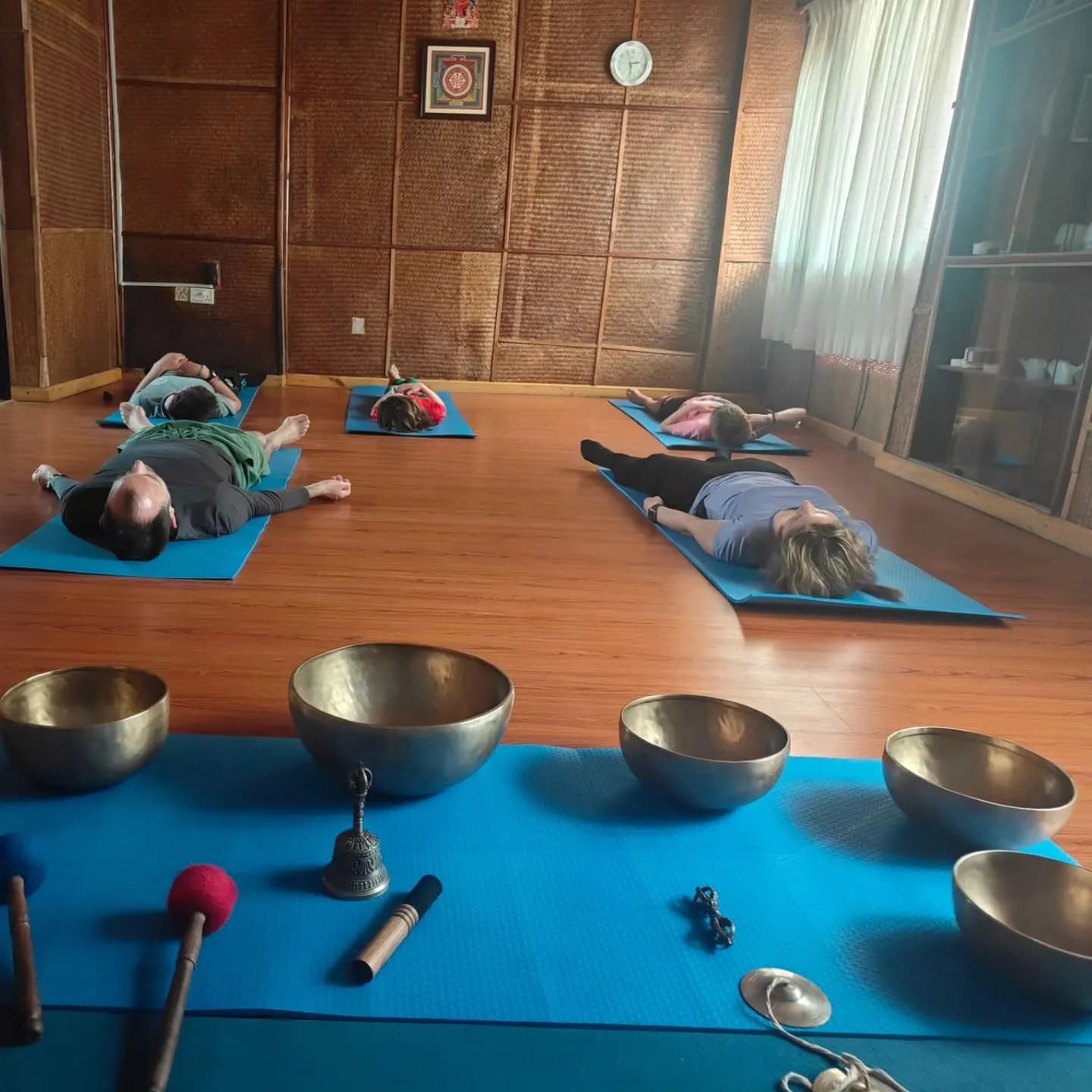
Bodhidham Yoga School and Retreat Ashram, set in the foothills of the Himalayas at Pokhara, Nepal, offers an eight-day Chakra Workshop and Healing Retreat that works through the seven chakras in sequence through yoga, meditation, pranayama, sound work, and guided practice. Contact the team to learn more about the programme and to book your place. The Himalayas have always been the natural home of this tradition, and there are few better places to meet it properly.
Frequently asked questions
- What are the 7 chakras and where are they located?
The seven chakras are energy centres in the subtle body, arranged along the central channel of the spine. From base to crown: Muladhara at the base of the spine, Svadhisthana just below the navel, Manipura at the solar plexus, Anahata at the heart centre, Vishuddha at the throat, Ajna between the eyebrows, and Sahasrara at the crown of the head.
2. Do chakras actually exist, or is it just spiritual belief?
The chakras exist as a classical map within the Tantric and Hatha Yoga traditions, described in detail in texts like the Sat Chakra Nirupana. They are not physical organs visible in anatomy, but they correspond in interesting ways with the nerve plexuses and endocrine glands of modern physiology. Whether one takes them literally or as a framework for attention and self-understanding, the map has been used productively by practitioners for centuries. The practices associated with each chakra- asana, pranayama, meditation, and mantra- have demonstrable effects on the body and mind, whatever one believes about the underlying model.
3. What is the root chakra and why is it important?
Muladhara, the root chakra, sits at the base of the spine and governs survival, stability, groundedness, and belonging. It is important because it is the foundation: without a stable root, the energy available for the higher centres has no ground to rise from. In practice, it is the starting place, the first thing a student works with, through grounding postures, physical care of the body, and building a sense of safety and presence.
4. What does it mean when a chakra is blocked?
In the yogic framework, a blocked or imbalanced chakra means the energy at that centre is not flowing freely, either too contracted or too diffuse. The signs vary by centre: a contracted Muladhara shows as anxiety and groundlessness, a contracted Anahata as emotional withdrawal and grief, a contracted Vishuddha as difficulty speaking honestly. The language of "blockage" is useful as a diagnostic shorthand. The remedy is sustained practice aimed at that centre, not a single session.
5. What is the difference between the seven chakras and kundalini?
The chakras are the map: seven centres arranged along the spine. Kundalini is the energy that moves through that map. In the classical teaching, kundalini is a latent force that ordinarily rests coiled at the base of the spine. As practice deepens and the body, breath, and mind are purified over time, this energy begins to rise through the chakras in sequence, and the qualities and obstructions of each centre are encountered and worked through.
6. Which chakra should a beginner focus on first?
Most traditional teachers recommend beginning with Muladhara, the root, because it is the foundation the others depend on. A practice that begins with grounding the body, establishing a stable relationship with physical existence, building a steady daily routine, and developing the capacity to be present, creates the conditions for the rest of the system to open naturally and safely. Rushing toward the upper centres without a stable root is like building a tall structure on loose ground.
7. What are bija mantras and how do they relate to the chakras?
Bija means seed in Sanskrit, and bija mantras are the seed syllables assigned to each chakra in the classical texts. They are LAM (Muladhara), VAM (Svadhisthana), RAM (Manipura), YAM (Anahata), HAM (Vishuddha), OM (Ajna), and silence or the totality of sound (Sahasrara). Repeating the bija mantra of a chakra, either aloud or silently in meditation, is understood to resonate with and activate that centre directly. The sounds are not arbitrary: they carry the precise vibrational quality of each element.
8. Can yoga help balance the chakras?
Yes, and this is one of the main reasons Hatha Yoga was developed. Different postures address different centres: standing poses ground Muladhara, hip openers work with Svadhisthana, core work and twists activate Manipura, backbends open Anahata, inversions and neck work address Vishuddha. A well-rounded yoga practice, paired with pranayama and meditation, tends to the whole system simultaneously. The effect is rarely dramatic or immediate, but over months and years of consistent practice, the map begins to make sense from the inside.