The traditional best time for meditation is Brahma Muhurta, a 48-minute window that begins 96 minutes before sunrise and ends 48 minutes before it.
At a glance
- Starts: 96 minutes before sunrise
- Lasts: 48 minutes, ending 48 minutes before sunrise
- Example: sunrise at 6:00 am gives 4:24 am to 5:12 am
- Moves: daily and with your location
That is the answer the texts give, and it is a good one. But it is only half of what a person actually needs, so here is the other half, said plainly at the start rather than buried at the end.
The best time for you is the earliest hour you can sit at every day without resenting it. A ten-minute sitting at 6:45 am that you keep for a year will change you more than a forty-minute sitting at 4:24 am that you keep for nine days and then abandon. The tradition is not confused about this. Patanjali makes duration and continuity the conditions of a practice taking root, not the clock reading.
So the honest structure of the answer is this:
1. Brahma muhurta is the best hour.
2. The hour you will actually keep is the best hour for you.
3. Move the second towards the first, slowly, over months, and you get both.
Everything below is in service of those three lines. In order, this guide covers:
- The arithmetic to find your own window
- Why the window moves, and when it is easiest to take up
- What the classical texts say, with verses
- The three sandhyas, and which practice suits which
- When to chant, a different answer from when to sit
- What we do at the ashram
What is brahma muhurta?
Brahma muhurta means "the hour of Brahma", the creator. It is also called the creator's hour, and the older texts sometimes place it under the wider heading of ushakala, the dawn time.
It is the second-to-last muhurta of the night. Counting the night as fifteen muhurtas, brahma muhurta is the fourteenth. The fifteenth and final one is the twilight that runs straight into sunrise. So brahma muhurta is not dawn. It is the stretch of dark that sits just before dawn, when the night is nearly finished but the day has not started.
That distinction matters more than it sounds. The hour is prized precisely because it belongs to neither state. It is a sandhi, a junction, a seam between two things. Traditional practice treats every seam in the day as an opening, and this is the widest one.
How to work out your own brahma muhurta
The calculation has three steps and needs nothing but your local sunrise time.
1. Find tomorrow's sunrise time for your exact location. Any weather app, any sunrise table, or a search for "sunrise time [your town]" will give it. Use your own town rather than a national average, because sunrise can differ by twenty minutes or more across a single country.
2. Subtract 1 hour and 36 minutes. That is 96 minutes, or two muhurtas. This is when brahma muhurta begins.
3. Add 48 minutes to that. That is when it ends. The window closes 48 minutes before sunrise.
Worked example. Sunrise at 6:32 am. Subtract 96 minutes, which gives 4:56 am. Add 48 minutes, which gives 5:44 am. Your brahma muhurta tomorrow is 4:56 am to 5:44 am.
If you want a rule of thumb you can hold in your head: brahma muhurta ends roughly when the sky first starts to lighten, and begins roughly three-quarters of an hour before that. Once you have done it for a week, you stop needing the arithmetic, because your body finds the hour on its own.
Why 48 minutes, and where does the number come from?
The 48 minutes is not arbitrary, and it is not a modern rounding. It is one muhurta, a fixed unit in the Vedic reckoning of time, and the whole day is built out of them.
| Unit | Length | How It Fits |
| Ghati (also Nadi) | 24 minutes | The base unit. 60 ghatis make one full day and night. |
| Muhurta | 48 minutes | Equal to 2 ghatis. 30 muhurtas make one full day and night. |
| Prahar (also Yama) | About 3 hours | Roughly 4 muhurtas. 8 prahars make one full day and night—4 in daylight and 4 in darkness. |
| Day | 30 muhurtas | 15 muhurtas from sunrise to sunset and 15 muhurtas from sunset to sunrise. |
Brahma muhurta is the 14th muhurta of the night, counting from sunset. Two muhurtas remain before sunrise when it begins, which is where the 96-minute figure comes from: two muhurtas of 48 minutes each.
This is also why brahma muhurta cannot be a fixed clock time. The muhurtas are pinned to sunrise and sunset, and those move with the season and with your latitude. Anyone who tells you brahma muhurta is "4:00 am" is giving you the answer for one place on one day of the year.
Why the window moves, and what that means for you
Because Brahma Muhurta is measured from sunrise, it is never the same clock time twice. Two things move it.
- The season moves it. Sunrise shifts through the year, so your window shifts with it. The further you live from the equator, the bigger that shift. Close to the equator, it barely moves at all. In northern Europe and the northern United States, it can swing by three or four hours between midsummer and midwinter.
- Your location moves it. Two towns an hour apart by road can have sunrise several minutes apart, and across a large country the difference runs to hours.
This is why no article can hand you a single number. What it can hand you is the method above, which works anywhere on earth on any day of the year.
Two practical consequences follow, and they are worth taking seriously.
- Winter is when this instruction is easy. In the darkest months, sunrise is late, so brahma muhurta lands at a perfectly normal waking hour. If you have ever wanted to try the pre-dawn practice and never managed it, start in winter. You are not being asked to do anything unusual, and the long nights do half the work for you.
- Midsummer is when it becomes unreasonable, and you should let it. If your local sunrise is very early, brahma muhurta can fall in the middle of the night. That is a latitude problem, not a discipline problem. The sensible response is to shift to the sunrise window instead, which is still fully traditional, and pick the earlier practice back up in the autumn. Nobody in the classical world was being asked to wake at three in the morning, because where the texts were written, nobody ever had to.
What the texts actually say
This instruction is often passed on as something "the ancient sages said." Here are the actual sources behind it, with the verses, so you can go and read them yourself.
Ashtanga Hridayam, Sutrasthana 2.1
This is the primary one, and it is a medical instruction rather than a spiritual one, which people find surprising.
ब्राह्मे मुहूर्ते उत्तिष्ठेत् स्वस्थो रक्षार्थमायुषः
> brahme muhurte uttishthet svastho rakshartham ayushah
> "A healthy person should rise in brahma muhurta, to protect their lifespan."
Note what it says and what it does not. It is addressed to the healthy person, svastha. Vagbhata, writing this chapter on dinacharya, is not telling the sick, the exhausted, or the recovering to get up at 4 am. It is a maintenance instruction for someone already well. That single word changes who the verse is speaking to, and it is worth holding onto.
The stated purpose is also worth reading carefully. It is not enlightenment. It is rakshartham ayushah, protecting the length of life. The classical argument for the early rise is a health argument first, and the spiritual benefits follow from a body that is in rhythm with the day.
Manusmriti and the older dharma texts
The Manusmriti gives the same instruction in a social and ritual register, telling the householder to rise in the last watch of the night, consider dharma and artha, and turn the mind towards what is true. Here the reason given is clarity of judgement rather than health. It is the hour in which you can think about your life without the day arguing with you.
Bhagavad Gita 6.16 to 6.17
Krishna gives the most balanced statement on this subject in the whole literature, and it is the verse least likely to appear in an article about waking at 4 am.
युक्ताहारविहारस्य युक्तचेष्टस्य कर्मसु
युक्तस्वप्नावबोधस्य योगो भवति दुःखहा
> yuktahara-viharasya yukta-cheshtasya karmasu
> yukta-svapnavabodhasya yogo bhavati duhkha-ha
> "For one who is regulated in eating and recreation, regulated in effort in work, and regulated in sleeping and waking, yoga becomes the destroyer of suffering." (6.17)
The verse immediately before it (6.16) says that yoga is not for one who eats too much or too little, nor for one who sleeps too much or too little. Both directions are named as failures.
This is the single most important corrective in the tradition to the modern enthusiasm for extreme early rising. Yukta means regulated, or yoked, not minimised. A person who cuts sleep to four hours to make brahma muhurta is not following this instruction, they are breaking it. Getting up at 4:30 is only virtuous if you were asleep by 9:30.
Yoga Sutras 1.14
स तु दीर्घकाल नैरन्तर्य सत्कारासेवितो दृढभूमिः
> sa tu dirgha-kala nairantarya satkara-asevito dridha-bhumih
> "Practice becomes firmly grounded when it has been cultivated for a long time, without interruption, and with sincere devotion." (1.14)
Three conditions, and notice that a time of day is not among them. Dirgha kala is a long time. Nairantarya is without a break. Satkara is with care and respect. Patanjali is describing what makes a practice take hold, and continuity is the condition he names, not the hour.
This is the verse to hold onto when you are deciding between the theoretically best hour and the hour you can actually keep. Nairantarya, unbrokenness, is the requirement. Everything else is optimisation.
Hatha Yoga Pradipika
Svatmarama's manual is practical about timing rather than devotional. It sets out the general rule that hatha practice belongs to the early morning, on an empty stomach, and it treats the seasons and the extremes of heat and cold as reasons to adjust rather than reasons to push through. Practice in the very hot part of the day and in the coldest part of the night are both discouraged. The moderate hours near dawn are what remain.
Why the hour before sunrise works
There are three separate explanations for why this window is prized, and they come from three different systems. They do not contradict each other, but they are not the same argument, and it is worth knowing which one you are being given.
The guna explanation
In Samkhya and in yoga, everything in nature carries three qualities, and the day carries them too. You can read the full account of sattva, rajas, and tamas separately, but the timing argument is simple.
- The deep night is tamasic. Heavy, dark, still, inert. Good for sleep and for very little else.
- The day is rajasic. Movement, activity, noise, wanting. Good for work.
- The seam between them is sattvic. As tamas releases its hold and before rajas takes over, there is a stretch where neither dominates, and what is left is clarity. That stretch is brahma muhurta.
The claim is not that the hour makes you sattvic. The claim is that the hour offers less resistance. Your mind still has to do the work, but it does it against a lighter headwind. Anyone who has tried to sit quietly at four in the afternoon and then at half past four in the morning knows the difference is not imaginary.
This also connects to [the five states the mind moves through](https://bodhidham.com/blog/five-states-of-mind). The scattered and dull states are harder to hold at dawn and easier to hold at midday, which is a large part of why the hour was chosen.
The dosha explanation
Ayurveda divides the twenty-four hours into six four-hour blocks, two for each dosha. This is the dosha clock, and it is the framework behind the whole of the classical daily routine.
| Time Window | Dosha | Quality | What It Suits |
| 2 am–6 am | Vata | Light, mobile, clear, airy | Waking, meditation, pranayama, and study |
| 6 am–10 am | Kapha | Heavy, cool, steady, earthy | Asana and physical practice; a substantial breakfast |
| 10 am–2 pm | Pitta | Hot, sharp, digestive | The main meal of the day and demanding mental work |
| 2 pm–6 pm | Vata | Light, mobile, creative | Creative work, walking, and light activity |
| 6 pm–10 pm | Kapha | Heavy, settling | Winding down, light dinner, and going to sleep |
| 10 pm–2 am | Pitta | Hot, processing | Deep sleep, digestion, and repair |
Brahma muhurta sits inside the pre-dawn vata window. Vata is the mobile, light, subtle principle, and its qualities are precisely the ones a meditator wants: lightness rather than heaviness, clarity rather than fog, subtlety rather than density. Waking inside the kapha window that follows at 6 am is the classical explanation for why a late waking leaves you groggy for hours. You have woken up inside the heavy part of the day.
If vata, pitta, and kapha are new to you, that guide explains the constitutions in full. For timing, the only part you need is the shape of the clock above.
The plain explanation
Everything above is true, and one more thing is true, and it may be the largest factor of all.
Nobody is awake. Nothing has been asked of you yet. No message has arrived. No decision is waiting. The road below the ashram is empty, and the village dogs have stopped. For most people, this hour is the only stretch of the twenty-four in which nothing at all is being demanded of them.
That is not mystical. It is just rare. And a mind that nothing is pulling at behaves very differently from a mind that has already started answering.
The three sandhyas: the other windows most people miss
Brahma muhurta gets all the attention, but the older ritual tradition works from a different structure: the sandhyas, the junctions. Sandhi means a joint or a seam. A sandhya is a point at which the day changes state, and there are three of them.
This is the framework behind sandhyavandanam, the daily Vedic observance, and it is the part of the tradition that answers "when should I chant" rather than "when should I sit".
| Sandhya | When | Traditional Window | Facing | What It Is For |
| Pratah Sandhya (Dawn) | Sunrise | 2 ghatis (48 min) before sunrise to 1 ghati (24 min) after | East | Gayatri japa, opening the day, and the main observance |
| Madhyahnika (Noon) | Solar noon | 1.5 ghatis (36 min) before noon to 1.5 ghatis (36 min) after | North | A brief pause and re-centring in the middle of activity |
| Sayam Sandhya (Dusk) | Sunset | 1 ghati (24 min) before sunset to 2 ghatis (48 min) after | West | Closing the day; japa continues until the stars appear |
Two things follow from this table that are useful even if you never perform sandhyavandanam.
- First, the dawn window and brahma muhurta overlap but are not the same. Brahma muhurta ends 48 minutes before sunrise. Pratah sandhya begins 48 minutes before sunrise. They meet exactly. Together they make a continuous stretch of about two hours and twenty minutes around dawn, and the tradition uses the first half for silent practice and the second half for chanting and ritual. If you have wondered why one teacher says "before sunrise" and another says "at sunrise," this is why. Both are right. They are describing adjacent windows.
- Second, there are three of these, not one. The noon and dusk junctions are genuinely part of the system, and both are far more accessible to a working person than 4:24 am. A person who cannot manage the dawn window and does nothing else has skipped two thirds of the framework.
Best time for each practice
Not everything belongs in the same hour. This is the part of the subject that almost no guide covers, and it is the part that changes what people actually do.
- Asana and hatha practice. Early morning, from around sunrise into the kapha window. The body is stiffest at dawn and warms as the kapha hours proceed. This is why our own class sits at 6:30 and not at 4:30.
- Surya Namaskar. Facing the sunrise, at or just after sunrise. It is a salutation to the sun, and it is traditionally performed as the sun appears. It also works as the warming bridge from stillness into asana.
- Mantra japa. Pratah sandhya, from 48 minutes before sunrise to 24 minutes after. The dawn junction is the classical window for japa, and the Gayatri specifically belongs here.
- Group chanting and kirtan. Early morning or evening. Evening suits group chanting well, because it carries energy without needing the silence that solitary practice requires.
- Yoga nidra. Early afternoon, or last thing at night. It is a lying-down practice that induces deep rest. In the early afternoon, it repairs the post-lunch dip, and at night it delivers people into sleep. Doing it at 4:30 in the morning mostly returns you to bed.
- Sound healing. Afternoon or early evening. The nervous system responds best when it has something to settle down from. We place ours in the afternoon for exactly that reason.
- Reflection, gratitude, and review of the day. Sayam sandhya, the hour around sunset. The dusk junction is for closing things. Reviewing your day at dawn is looking at the wrong end of it.
The general principle behind the whole table: stillness practices belong before the day, movement practices belong at the start of it, and settling practices belong at the end of it. If you remember nothing else from this section, that ordering will keep you right.
The best time to chant mantras
This deserves its own section because the answer is different from the answer for silent meditation, and because it is the question we are asked most often after the timing question itself.
The general rule
Mantra japa belongs to the sandhyas, the three junctions of the day, and above all to the dawn junction. The classical window is pratah sandhya: from about 48 minutes before sunrise until about 24 minutes after. If you chant once a day, chant then.
The reason given is the same one that governs the rest of the system. A junction is a moment when one state is releasing, and the next has not arrived. Sound placed into a mind in that condition goes further than sound placed into a mind already running.
Which mantra, which window
| Practice | Traditional Window |
| Gayatri mantra | All three sandhyas, especially dawn. Face east at dawn, north at noon, and west at dusk; continue until sunrise or the stars appear. |
| Om, or a single seed syllable | Brahma muhurta or dawn. Also suitable as an opening for meditation at any hour. |
| Ashtanga opening chant | Immediately before practice, regardless of the practice hour. See the Ashtanga opening and closing chants for the text and meaning. |
| Ashtanga closing chant | Immediately after practice, before leaving the mat. |
| Vishnu Sahasranama | Traditionally in the morning after bathing, during or shortly after pratah sandhya. Also commonly chanted on Saturday mornings. |
| Rudri path and Rudrabhishek | Morning, beginning around pratah sandhya and continuing into the early morning. Longer recitations start early. |
| Mahamrityunjaya mantra | Brahma muhurta or dawn. The pre-dawn period is traditionally prescribed. |
| Evening and devotional chanting, aarti | Sayam sandhya, around sunset. |
You will find our full collection of [mantras and their meanings](https://bodhidham.com/mantras) with transliteration and translation, which is the place to start if you want to learn one properly before worrying about when to chant it.
What actually matters more than the hour
Three things, and they all outrank the clock.
- Bathe first, or at least wash. Every tradition that prescribes a time also prescribes cleanliness before chanting. This is more consistently insisted upon than the timing is.
- An empty or near-empty stomach. Chanting on a full stomach is uncomfortable, and the breath cannot support the sound.
- The same time each day. A mantra practice that happens at 6:40 every morning becomes something. A mantra practice that happens at 4:24 on Tuesday, 9:00 on Thursday, and not at all on Friday does not, no matter how well timed Tuesday was.
Auspicious time, panchang, abhijit muhurta, and rahu kaal
A lot of people arrive at this question through the panchang rather than through yoga, and they are asking something slightly different: not "when is the good hour of the day" but “is today a good day, and which part of it”
The honest answer has two halves, and both halves need saying.
What these terms mean
- Panchang means "five limbs". It is the traditional almanac, and the five limbs are tithi (the lunar day), vara (the weekday), nakshatra (the moon's constellation), yoga (a sun and moon combination), and karana (half a tithi). Together they describe the quality of a given moment. A muhurta, in the astrological sense, is a window selected using these five.
- Abhijit muhurta is the eighth of the fifteen daytime muhurtas, the one centred on local solar noon. It runs roughly 24 minutes either side of true midday. Abhijit means victorious, and it is treated as generally auspicious for beginning things, and as an override that cancels most other flaws in the chart of the moment.
- Rahu kaal is a period of about ninety minutes each day, at a different time depending on the weekday, traditionally avoided for starting new ventures, journeys, purchases, and ceremonies.
Morning, midday, or evening: an honest comparison
| Morning | Midday | Evening | |
| The window | Brahma muhurta to just after sunrise | Around solar noon, madhyahnika and abhijit | The hour around sunset, sayam sandhya |
| Best for | Silent meditation, pranayama, japa, setting the tone of the day | Resetting a scattered day, a short second sitting | Winding down, reflection, gratitude, sleep |
| The mind is | Quiet, uncluttered, slightly slow | Busy but responsive, needs a firm hand | Tired, full of the day, easily distracted but easily softened |
| The body is | Coolest, stillest, lightest, not yet warmed | Warm and at its most alert, digestion strongest | Warm but tiring, settling towards sleep |
| Main advantage | Nothing has interrupted you yet | It is the only window some working people can protect | Easiest to keep, no alarm required |
| Main risk | Unsustainable if you are not also going to bed early | Hard to shift out of work mode, easily cancelled | Falling asleep, and the day's residue taking over the sitting |
| Verdict | The strongest window, and the hardest to keep | The most underrated, and the most practical for office workers | The best place to start if mornings are not possible yet |
If you are choosing one and only one, choose morning if you can protect the bedtime that makes it possible, and evening if you cannot. Do not choose morning and then sleep at midnight. That is the failure mode this whole subject produces most often, and Krishna named it in Gita 6.16 twenty-five centuries before anyone had an alarm clock.
The empty stomach rule, and the gap after meals
Every traditional instruction about timing carries a food instruction with it, and it is easy to overlook. It should not be, because it is the one that most often ruins a well-timed practice.
Sit on an empty or near-empty stomach. Digestion pulls blood to the gut, raises body temperature, produces drowsiness, and makes the breath heavy. All four work against what you are trying to do.
The traditional gaps:
| After | Wait Before Practising |
| A full meal | 3 to 4 hours |
| A light meal or a snack | 1 to 2 hours |
| A glass of milk or juice | 30 to 45 minutes |
| Water | No wait needed |
This is a large part of why the pre-dawn window is prized in the first place. It is the only hour of the day that is naturally and effortlessly on an empty stomach. You do not have to plan anything. You have not eaten since dinner.
For an early morning sitting, warm water is fine and traditionally recommended, and a cup of plain tea will not ruin anything. Coffee before meditation is a personal experiment that most people eventually stop running.
What if you cannot wake at 4 am
Most people cannot, and a good many should not, and that deserves saying plainly rather than leaving people to feel they have failed at something.
If you work night shifts or rotating shifts
Brahma muhurta is not defined by the clock; it is defined by sunrise, and your body is not defined by either. If you finish work at 6 am, the pre-dawn window is the end of your working day, not the start of your rested one, and sitting in it will do very little.
What transfers is the principle, not the hour. The principle is: practise in the seam before your day begins, on an empty stomach, before anything has been asked of you. For a night worker that seam might be 4 pm. Take it. The tradition's own logic supports this better than a literal reading does.
If you are a parent of small children
Your window is whichever twenty minutes exist. Frequently that is after the house is asleep, and that is a real window. Yoga nidra and a settling practice suit it better than an alert seated meditation. Take what the day offers rather than mourning the window you cannot reach. It will come back in a few years.
If you are a night owl by constitution
Chronotype is real and substantially genetic. A confirmed late type forced onto an early schedule does not become an early type, they become a tired late type. If you have tried mornings for months and never once felt the benefit that everyone describes, the honest conclusion is that you are not doing it wrong; you are doing someone else's schedule.
The move that works is small and slow. Shift your bedtime fifteen minutes earlier a week, and let waking follow it. Do not shift the waking first. Waking earlier without sleeping earlier is just sleep deprivation with a spiritual justification, and Gita 6.16 rules it out by name.
If you are unwell, exhausted, or recovering
Go back and read the Ashtanga Hridayam verse again. It is addressed to svastha, the healthy person. If you are ill, burnt out, or in the middle of something hard, the classical instruction does not apply to you and was never meant to. Sleep. Sit later, and sit shorter. The practice will wait.
The compromise that actually works
For almost everybody who writes to us about this, the answer is the same, and it is unglamorous.
Do not aim for brahma muhurta. Aim for the sunrise window. Sit for fifteen minutes in the half hour around sunrise. It is one of the three sandhyas, it is fully traditional, it is roughly ninety minutes more humane than brahma muhurta, and it is a schedule an ordinary person with a job can hold for years.
Then, if the practice deepens and your bedtime comes forward on its own, the earlier window will start to look possible rather than punitive. In our experience, that is the direction it happens in. Nobody arrives at brahma muhurta by deciding to. They arrive at it by going to bed earlier and earlier until one morning they are simply awake.
Building the habit, practically
The timing question is really a habit question wearing a costume. Here is what works, in the order it works in.
- Move the bedtime, not the alarm. This is the whole thing. Nothing else on this list matters if you skip it. Decide what time you must be asleep for the waking time to be survivable, then work backwards to when the screens go off.
- Start with ten minutes. Not thirty. Ten minutes that happens is infinitely more valuable than thirty that does not. Length can grow later and it usually does so on its own.
- Sit in the same place. A specific corner, a specific cushion, a specific direction. The body learns the location and starts settling before you do. This is a real effect, and it arrives after about two weeks.
- Do it before you look at a phone. Not as a moral position. As a practical one. Once the phone is open, the day has begun, and the seam has closed.
- Keep the chain unbroken rather than perfect. This is nairantarya, Patanjali's second condition. A three-minute sitting on a bad day keeps the chain. A missed day breaks it, and two missed days usually end it. On the worst day of the month, sit for two minutes and count it.
- Expect week three to be the hard one. Novelty carries you through the first two weeks. The third is when it becomes a decision rather than an enthusiasm. If you know it is coming, it passes.
Do not chase the good sittings. Some mornings are clear, and some are noise, and which one you get is not under your control and is not a report card. The practice is the sitting, not the quality of the sitting. Read the account of the five states the mind moves through if this needs more explanation, because it is the single most common reason people quit.
What we actually do at Bodhidham, and why it is not 4 am
Having spent this article explaining why the hour before sunrise is the best hour, honesty requires the next paragraph.
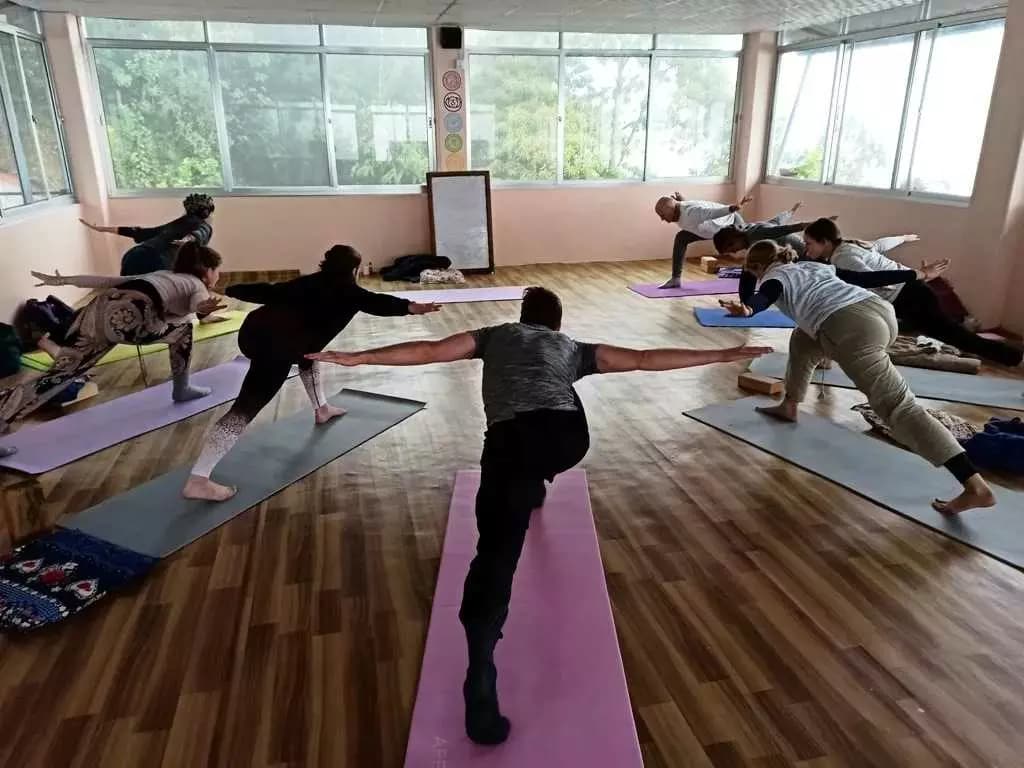
The bell at our ashram is at 6:15 am, not 4:24. Morning cleansing at 6:15. Classical hatha yoga at 6:30. Breakfast at nine. Guided meditation in the evening at six. That is the frame, and it does not change.
Here is why, and the reasoning matters more than the times.
- In summer it would be unreasonable. At the height of the year, Brahma Muhurta here falls well before four in the morning. A guest two days off a long flight, still carrying the jet lag, will not have a spiritual experience at that hour. Which month you come changes what is reasonable to ask.
- A fixed 4 am bell would drift out of the window anyway. Brahma muhurta moves across the year, so a fixed bell sits inside it for part of the year and outside it for the rest. Ours holds the pratah sandhya and early kapha windows all year instead.
- Asana at 4 am is bad asana. The body is coldest and stiffest before dawn. Silent sitting suits that. Classical hatha does not, which is why it goes at 6:30, once the kapha window has begun to warm the body.
- We would rather you kept the schedule than admired it. A timetable half the guests cannot follow leaves a group exhausted by day four, and a tired group learns nothing. Ours is set where an ordinary person can hold it for a week and then take it home. What the first week is actually like]() covers the rest.
If you want to live inside this rhythm rather than read about it, our week-long retreat in Pokhara is built around it, and a silent meditation retreat uses the same frame and removes the talking. There is more on why people practise in Nepal specifically, and the short version relevant to this article is that the mornings here are genuinely dark, genuinely quiet, and genuinely cold, which is a set of conditions most people cannot manufacture at home.
Five mistakes people make with timing
- Waking early without sleeping early. Named in the Gita, named at the top of this article, and still the most common failure by a wide margin. Cutting sleep to reach a spiritual window is not the practice; it is the opposite of it.
- Treating brahma muhurta as a fixed clock time. It is tied to sunrise, so it moves every day and with every location. "4:00 am" is one day's answer for one place.
- Waiting for the right time to start. The number of people who research the optimal window for six weeks and never sit down once is not small. Start tonight, at whatever hour is left. Move the hour later.
- Practising asana in the coldest hour and meditating in the warmest. This is timing applied backwards, and it is surprisingly common in people who have read half of the tradition. Stillness before the day, movement at the start of it.
- Abandoning the whole thing after a broken week. The chain is meant to be repaired, not preserved unbroken from the first day. Nobody's is. Sit today.
Frequently asked questions
- What is the exact time of brahma muhurta today?
Find today's sunrise for your town, subtract 1 hour and 36 minutes for the start, then add 48 minutes for the end. If the sun rises at 6:45 am, your window is 5:09 am to 5:57 am. If it rises at 8:00 am, your window is 6:24 am to 7:12 am.
2. How long before sunrise is brahma muhurta?
It begins 96 minutes before sunrise and ends 48 minutes before sunrise. The window itself is 48 minutes long.
3. Why is it 48 minutes?
Because a muhurta is a fixed unit of 48 minutes in Vedic time reckoning. Thirty muhurtas make a day and night, fifteen in daylight and fifteen in darkness. Brahma muhurta is the fourteenth muhurta of the night, so two muhurtas remain before sunrise when it begins.
4. Is Brahma muhurta the same time everywhere in the world?
No. It is calculated from local sunrise, so it differs by location and by day. The further you are from the equator, the more it swings across the year. In northern Europe, in midsummer it can fall around 2 am, which is one reason the instruction has to be read as a principle rather than a clock time.
5. Why is brahma muhurta a different time every day?
Because it is measured from sunrise rather than from the clock, and sunrise moves a little every day. It also changes with where you are. This is why the calculation matters more than any number somebody hands you, and why the same instruction is easy to keep in winter and very hard in midsummer.
6. Is 4 am or 5 am better for meditation?
Neither, in the abstract. What matters is your position relative to sunrise, not the number on the clock. If the sun rises at 5:30, then 4 am is inside the window, and 5 am is past it. If the sun rises at 8:00, then 4 am is more than two hours too early, and 6:30 is the hour you want.
7. Can I meditate at night instead?
Yes. The dusk junction, sayam sandhya, is a genuine traditional window, and evening practice suits reflection, gratitude, and settling. It is also the easiest window to keep, which counts for a great deal. The one thing evening does badly is alert seated concentration on a tired mind, so keep evening sittings shorter and gentler.
8. Is there a bad time to meditate?
Two, practically. Directly after a full meal, when digestion will defeat you, and in the middle of the night when you should be asleep. Beyond that, no hour is forbidden. The tradition ranks hours; it does not ban them.
9. Does Rahu kaal apply to meditation?
No. Rahu kaal concerns the beginning of worldly undertakings such as journeys, purchases, and ceremonies. Nothing in the classical literature tells a practitioner to skip their daily sitting because of it. If your usual hour falls inside Rahu kaal, sit anyway.
10. What is the difference between brahma muhurta and abhijit muhurta?
Brahma muhurta is the pre-dawn window, the fourteenth muhurta of the night, and it is the classical time for meditation and sadhana. Abhijit muhurta is the eighth muhurta of the day, centred on solar noon, and it is treated as auspicious for beginning ventures. Brahma muhurta is a practice window; Abhijit is an event window.
11. What is the best time to chant the Gayatri mantra?
The three sandhyas, and the dawn one above all: from about 48 minutes before sunrise to about 24 minutes after, facing east. Traditionally, the japa continues until the sun is visible. Noon facing north and dusk facing west are the other two.
12. What is the best time to chant Vishnu Sahasranama?
Traditionally, morning, after bathing, in or shortly after the dawn window. Many households keep it for Saturday morning specifically. If you cannot manage the morning, an evening recitation is far better than none.
13. Should I meditate before or after yoga?
In most traditional sequences: cleansing, then pranayama, then asana, then meditation. That said, a short sitting before asana settles the mind for the practice, and a short sitting after asana benefits from a body that has already released. Many schools do both, and if you only have room for one, put it after asana, when the body is no longer arguing.
14. Can I meditate after eating?
Not straight after. Allow three to four hours after a full meal, one to two after something light, and thirty to forty five minutes after milk or juice. Water needs no gap. This is precisely why the pre-dawn window is so convenient: it is naturally empty.
15. What if I work night shifts?
Apply the principle rather than the clock. Practise in the seam before your day begins, on an empty stomach, before anything has been asked of you. If your day begins at 4 pm, that is your window. Trying to hold a 4 am sitting on a night-shift schedule is the literal reading of the instruction and the wrong one.
16. Do I have to wake up at 4 am at an ashram?
Not at ours. Our morning bell is at 6:15, with cleansing at 6:15 and hatha yoga at 6:30. Some ashrams do start earlier and you should ask before you book, because a 4 am bell is a very different week from a 6:15 one. Our hall is open before the bell for anyone who wants the earlier hour, and nobody is woken for it.
17. Should beginners start in the morning?
Start at whichever time you can repeat. For most beginners, that is evening, because it needs no alarm and no change to your sleep. Once the habit exists, move it earlier in small steps. Building the habit first and optimising the hour second is the order that works. The reverse order is how most people quit in week three.
18. Is morning meditation better than evening for anxiety?
There is a reasonable case for morning. For many anxious people, the worrying starts within the first half hour of waking, before the day has given them anything real to worry about. A sitting placed at the front of the day, before that pattern gets going, can set a calmer tone for the hours that follow. But an evening practice that you keep beats a morning practice that you abandon, and for anxiety specifically, consistency matters more than placement.
19. Does the time matter more than the length?
No. Consistency outranks both. Patanjali's three conditions in Yoga Sutra 1.14 are a long time, without interruption, and with sincerity. The hour is not among them. Ten minutes daily beats an hour on Sundays, whatever the hour on Sunday is.
Where to start tomorrow
If you have read this far and want one instruction rather than twenty, here it is.
Look up tomorrow's sunrise for your town. Set an alarm for thirty minutes before it. Sit for ten minutes before the phone, in the same place you will use next time. Then go about your day.
Do that every day for three weeks and you will have learned more about the best time for meditation than any article can teach you, including this one. The tradition gave us the arithmetic and the texts and the reasoning, and it also gave us the honest bit at the end: none of it does anything until somebody sits down.