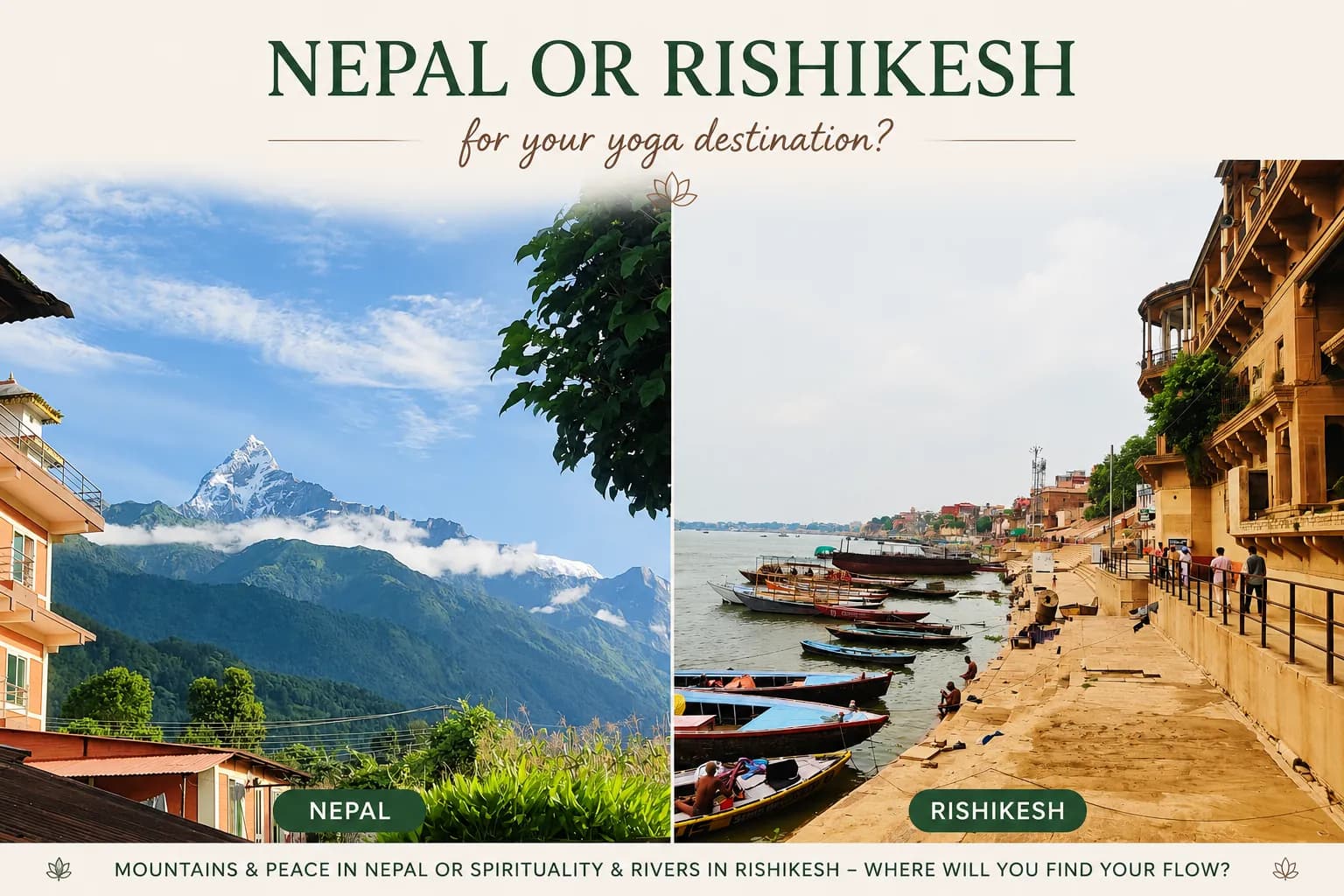
If you have decided to travel for your practice, and you are looking at the Himalaya rather than a beach, you will end up with these two on our comparison table.
Rishikesh, in the Indian foothills on the Ganga. Or Nepal, usually Pokhara and the hills above it, under the Annapurna range.
Most of what is written about this reads like an argument. It should not be. Bodhidham is in Pokhara, Nepal, and we are not telling Nepal is superior to Rishikesh. Both are genuinely good, both have long histories, and both send students home changed. What they are not is interchangeable, and the differences between them are practical rather than moral.
This article sets out what actually differs, so you can match the place to the trip you want.
- Rishikesh if you want choice, the Ganga, the greatest concentration of schools and teachers anywhere, and a town where everything is arranged around practice.
- Nepal if you want quiet, small groups, high mountains outside the window, and the option of walking into the Himalaya when the course ends. Both are excellent. Read on for the details that decide it.
Rishikesh, a town built around practice
It is worth describing Rishikesh properly, because a lot of the writing about it is either dismissive or breathless, and it deserves neither.
The river is the reason
Rishikesh sits where the Ganga comes down out of the mountains onto the plain, at around 370 metres above sea level. For Hindus, the Ganga is the holiest river there is, and a great deal of what the town feels like comes from being beside it.
Every evening there is the Ganga Aarti on the ghats, when hundreds of people gather with lamps and chanting as the light goes. Almost everyone who sees it remembers it.
The scale is genuinely remarkable
Rishikesh is often called the yoga capital of the world, and the numbers behind that are real. There are more than two hundred Yoga Alliance registered schools in the town. The International Yoga Festival has run there every March since 1999 and draws thousands of people from around the world.
Nowhere else on earth has that density. If you want to sit with several teachers, try more than one tradition, or simply be surrounded by hundreds of other people doing the same thing you are doing, there is no substitute for it.
The great ashrams
Parmarth Niketan, the Sivananda ashram, Swarg Ashram and others line the river. Many run daily classes, discourses and satsang that are open to anyone. Between them you will find almost every branch of the practice being taught, from hatha and ashtanga through to breath work, meditation, mantra and philosophy.
The town spreads across a few areas that students come to know well. Swarg Ashram and Ram Jhula on one side, Laxman Jhula and Tapovan further up. Each has its own character and its own cluster of schools.
The town lives by the practice
Rishikesh has been vegetarian and alcohol free by long custom. That is not a rule imposed on visitors; it is simply how the town runs, and many students find it takes a lot of the friction out of the first week.
Nepal, and the retreats on the lap of mountains
Nepal sits along the Himalaya to the east, and the practice here works differently for reasons of geography as much as anything else.
The mountains are the setting, not the backdrop
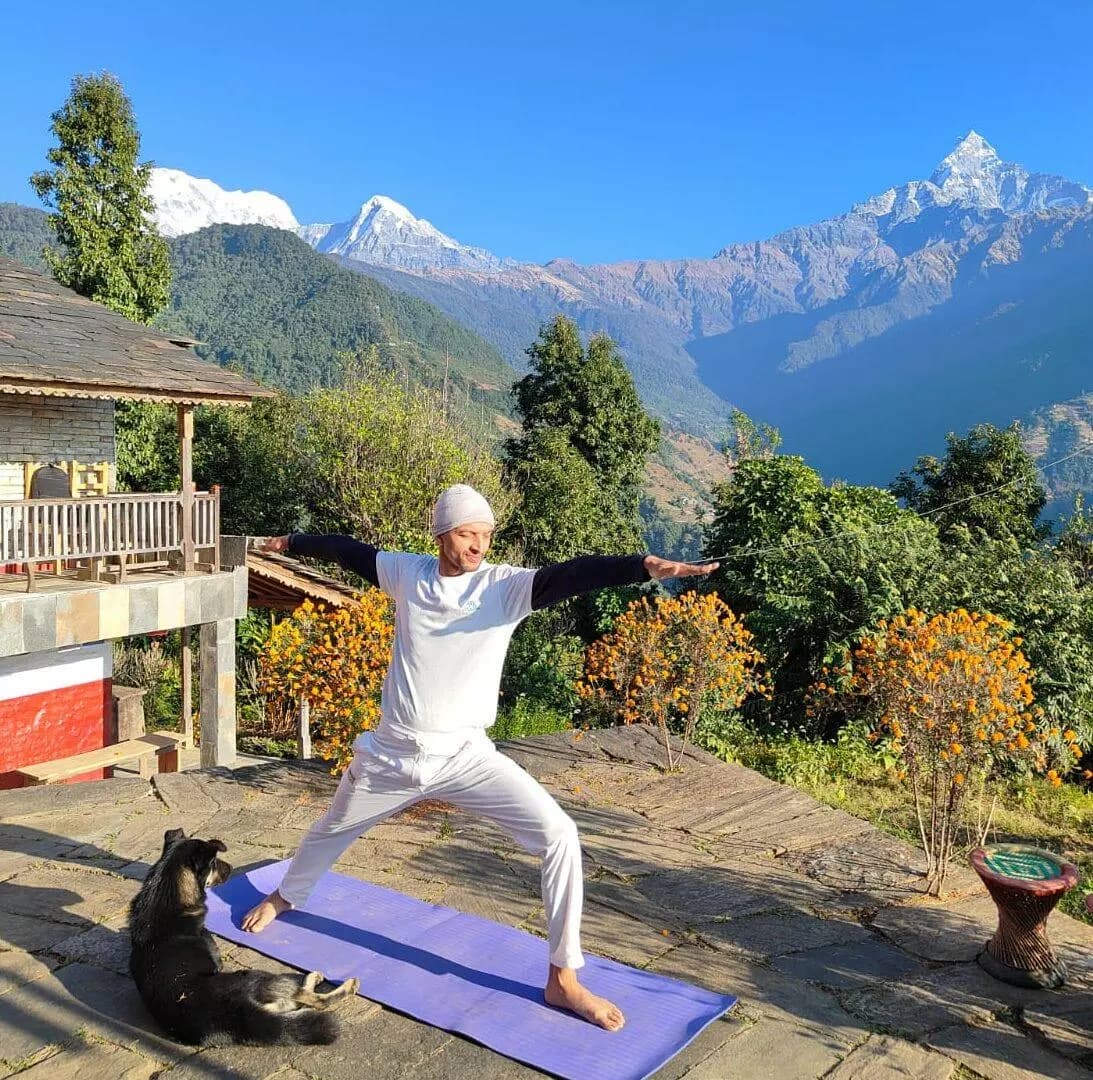
Most Nepali retreats and trainings run around Pokhara, which sits at 822 metres under the Annapurna range. The hill villages above the town sit between roughly 1,300 and 1,600 metres. Our own ashram is at Ghachowk at 1,320 metres, about thirty minutes above Pokhara.
From up there, Machhapuchhre stands directly in front of the building. Nepal has refused every climbing permit for that mountain since 1957, because the peak is held to be a home of Shiva. Nobody has stood on it.
The groups are small
There are fewer schools here than in Rishikesh, and many of them are residential ashrams rather than centres, so the number of students is limited by the size of the building rather than by demand.
For some people, that is the entire reason to come. The same teacher every day, a group small enough that nobody drifts, and a teacher who notices on the morning you are struggling.
The country has its own claim on the tradition
Nepal is not a substitute Himalaya. It has its own history, and it is a serious one.
The oldest surviving complete Shaiva tantra reaches the world through a ninth-century palm leaf manuscript from Nepal. The Buddha was born at Lumbini in the south of the country. Matsyendranath, founder of the Nath order that produced hatha yoga, is worshipped in Patan as Rato Machhindranath and carried through the streets on a chariot every year. Gorakhnath's meditation seat is at Mrigasthali, inside the Pashupatinath grounds.
Nepal was also never colonised, so the practice here was never suppressed and never had to be rebuilt from texts afterwards. It carried on in temples, villages and families without a break.
Our pages on hatha yoga and the eight limbs go into the tradition itself.
The mountains are walkable from the door
Poon Hill, Mardi Himal and the Annapurna routes all begin near Pokhara. A great many students finish a course and start walking within a day or two. Our yoga treks practise at either end of each walking day, and there is more on why the two go together in our piece on yoga and trekking.
The differences that actually change your day
Now the practical part. Five things genuinely differ, and each one changes what a month feels like.
1. Altitude, and what it does to breathing
This is the difference most people never think about and then notice immediately.
Rishikesh sits at around 370 metres, in a river valley. The hill ashrams around Rishikesh sit at 1,300 to 1,600 metres. That is a difference of roughly a kilometre in height.
At that altitude, the air is cooler, drier and slightly thinner. It is nowhere near thin enough to trouble a healthy person, but it is different enough that most students notice their breathing change within three or four days, particularly in nadi shodhana and the longer retentions.
Neither is better. Warmer, denser air is easier on the body in the first week. Cooler, thinner air makes the breath more noticeable. It simply depends which you would rather practise in.
2. Temperature, and which months work
The two places have different comfortable windows, and this catches people out.
Rishikesh is at its best from roughly February to April and again from September to November. May and June get very hot, with daytime temperatures reaching around 36 degrees, and July to September bring the heaviest rain. January days are pleasant at around 19 degrees.
Nepal's hills have two clear windows too, October to November and March to May, with the mountains fully out. December to February is cold in the mornings and very quiet, with lovely visibility in January. June to September is the monsoon, when the peaks stay behind cloud.
So the overlap is real but not complete. If you can only travel in May, the Nepali hills will be more comfortable than the plain. If you can only travel in January, both work, though Nepal will be colder at dawn. Our month-by-month guide covers the Nepal side in detail.
3. Choice versus attention
This is the real trade-off, and it is worth being clear about it because it cuts both ways.
Rishikesh has more than two hundred registered schools. That means enormous choice. You can find almost any style, any price point, any length, and you can sit with several teachers in one trip. If your first choice does not suit you, there is another one along the road.
Nepal has far fewer. That means less choice, and it also means smaller groups. On a typical Nepali residential course you will have the same teacher for the whole course, in a group small enough that they know how you slept.
Neither is the right answer for everybody. Some students are lifted by being one of forty. Others find that after a week they cannot hear themselves. Be honest about which one you are, because it will shape your month more than the syllabus will.
4. A river or a mountain
This sounds like decoration, and it is not.
In Rishikesh, the Ganga is the centre of everything. The practice, the ceremony, the walks, the evenings. It is a river town, and the river sets the tone.
In the Nepali hills, the mountains do that job. Practice happens facing them, the walks go up into them, and the weather is decided by them.
Which of those you want to look at for three weeks is a genuine question and worth answering honestly.
5. What happens after the course
Rishikesh puts you in northern India, so the natural continuation is Haridwar, the hill stations, Delhi, and onward travel across a very large country.
Nepal puts you inside the Annapurna region, so the natural continuation is a trek. That is the single clearest practical difference between the two, and for some people it decides it on its own.
The practical side
Visas
This is worth planning properly, and the two countries work differently.
| India | Nepal | |
| Type | e-Visa, applied for in advance online | Visa on arrival at the airport |
| Cost | Around 25 US dollars for 30 days, plus a small processing fee | 30 US dollars for 15 days, 50 for 30 days, 125 for 90 days |
| When to apply | Up to 60 days ahead. Approval usually 24 to 72 hours | On the day you land |
| Time it takes | A few days online before you travel | Usually 15 minutes to an hour at the airport |
Getting there
- Rishikesh is reached through Delhi, then either a domestic flight to Dehradun or a road journey of around five to six hours.
- Nepal is reached through Kathmandu, then either a 35-minute flight to Pokhara at roughly 75 to 130 US dollars, or a tourist bus of six to eight hours at 15 to 25 dollars.
Side by side
| Rishikesh | Nepal, Pokhara and the hills | |
| Setting | The Ganga, at the edge of the plain | The Annapurna range, in the hills |
| Altitude | Around 370 m | Town 822 m, hill ashrams 1,300 to 1,600 m |
| Choice of schools | More than 200 registered | Far fewer |
| Group sizes | Often larger, wide range | Usually small, often residential |
| Best months | February to April, September to November | October to November, March to May |
| Hottest period | May and June, up to around 36 degrees | Hills stay mild through the year |
| Atmosphere | Devotional, busy, everything arranged around practice | Quiet, rural, farming villages |
| After the course | Northern India, hill stations, onward travel | Annapurna treks from the doorstep |
| Visa | e-Visa in advance, around 25 dollars | On arrival, 30 to 125 dollars by length |
Which one suits which student
You will probably prefer Rishikesh if:
- You want to try several teachers and traditions in one trip
- The devotional side of yoga is a large part of why you are going
- Being surrounded by hundreds of other practitioners energises you rather than tiring you
- You want the widest possible choice of schools, styles and price points
- You are travelling in the shoulder months and want warmth
You will probably prefer Nepal if:
- You want a small group and the same teacher every day
- You would rather have quiet than choice
- Cold, dark, silent mornings sound like the point rather than the price
- You want to walk in high mountains when the course finishes
- You like the idea of a tradition that never had an interruption in it
Either will work well if you are a complete beginner, if you want a 200-hour training, or if you are mainly going for the discipline of a residential month. Both do those things properly.
What does not change with the country
It is worth saying plainly that the most important things travel with you.
- The teacher decides your experience. Not the country, not the view, not the price. Who is standing in front of you at half past five in the morning matters more than everything else on this page put together.
- The practice is the same practice. A sun salutation on the Ganga is a sun salutation in Ghachowk. What changes is the air around it and the people beside you.
- Nobody makes you practise. The students who get the most out of a month away are the ones who would have practised at home too, and the place simply removed the excuses.
- The small print matters more than the setting. Whether the course is residential, how many students are in the group, whether the same teacher takes you the whole way through, and what is genuinely included in the fee.
So the question worth asking any school, in either country, is the same one. Who taught the person who is going to teach you, where did they train, and for how long? A school in a real line answers that without hesitating, and will usually name their own teacher.
If you are still deciding how long to train for, our guide to choosing between 100, 200 and 300 hours walks through who each level suits.
Frequently asked questions
- Is Rishikesh or Nepal better for yoga teacher training?
Both are good, and the honest answer depends on what you want. Rishikesh gives you the widest choice of schools and traditions anywhere in the world, and a town built entirely around practice. Nepal gives you smaller groups, mountains, cooler air and quieter surroundings. If choice matters most, Rishikesh. If attention matters most, Nepal.
2. Which is more traditional?
Both have serious claims, and it is not a competition. Rishikesh sits on the Ganga among some of the most respected ashrams in India. Nepal holds the ninth-century manuscript through which the oldest surviving Shaiva tantra reaches us, the birthplace of the Buddha, and the seats of the founders of the Nath order that produced hatha yoga. The Himalaya was one region of practice long before it was divided into countries, and lineages moved freely across all of it.
3. Is one cheaper than the other?
Course fees sit in broadly the same range, and the gap between two schools in the same town is usually larger than the gap between the two countries. India's e-Visa is cheaper than Nepal's 30-day visa. Nepal adds the cost of getting from Kathmandu to Pokhara. None of these differences is large enough to decide it on its own.
4. Which is better for a complete beginner?
Both take beginners well. What matters more than the country is the group size and the pace. A beginner usually does better in a small group with a gentle traditional style, where the teacher can see everybody in the room.
5. Which has better weather?
They have different windows. Rishikesh is most comfortable from February to April and September to November, and gets very hot in May and June. The Nepali hills are at their best in October and November and again from March to May, and stay mild through the summer because of the altitude. If your travel dates are fixed, that may settle the question for you.
6. Can I do both?
Yes, and some people do, usually a training in one and a shorter retreat in the other on a later trip. Doing both in a single journey is possible but tiring, since it means a flight or a long overland crossing in the middle of it.
7. Which is better if I want to trek afterwards?
Nepal, comfortably. Poon Hill, Mardi Himal and the Annapurna routes start near Pokhara, so you can finish a course and be walking the next morning. There is more on that in our piece on the Poon Hill yoga trek.
8. Is the certificate different?
No. What matters is whether the school is registered with Yoga Alliance, not which country it sits in. Registered schools in both countries issue the same recognised certificate. Always check the school's own registration rather than assuming from the location.
9. What if I have never stayed at an ashram before?
That describes most people who go to either place. Our piece on your first week at an ashram walks through what daily life is actually like, and most of it applies in both countries.
A last thought
Rishikesh and the Nepali hills are not rivals. They are two parts of the same mountain range, and the tradition moved across both of them for centuries before anybody drew a border through it.
What differs is the shape of the mountain. One offers you a town full of teachers, a holy river and the largest gathering of practitioners in the world. The other offers you a village, a small group, cold quiet mornings and a mountain that has never been climbed.
Choose the one that matches the month you actually want, ask the school the questions above, and then do the practice. That last part is the same wherever you are, and it is the part that decides what you bring home.
If the Nepali hills sound like the right fit, our yoga retreats in Nepal run from three days upward, and our teacher training courses run through the year, at 1,320 metres in a Gurung village about thirty minutes above Pokhara.