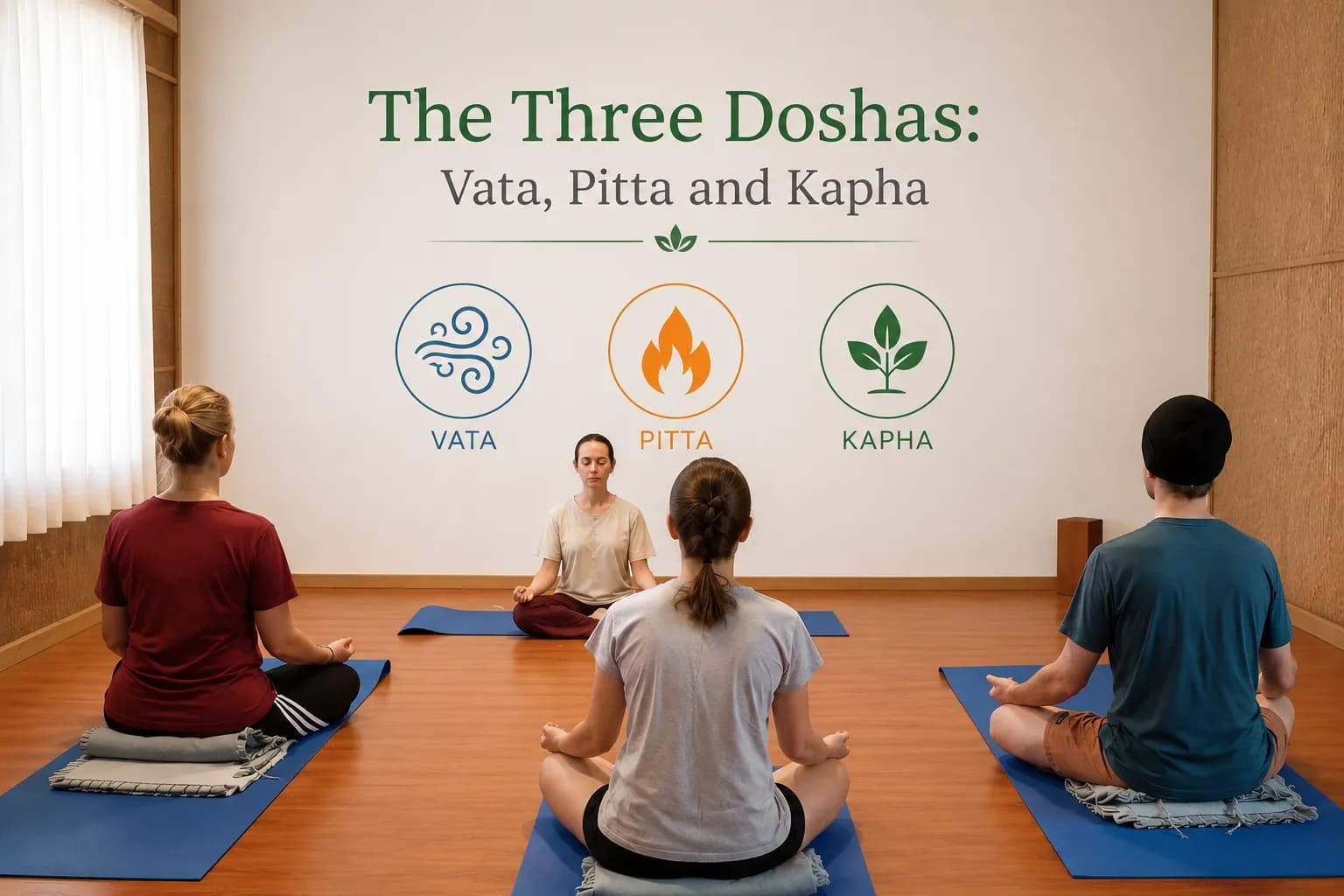
Vata, pitta, and kapha are the three doshas of Ayurveda, the biological energies built from the five elements that shape how your body moves, digests, builds tissue, and holds itself together. Vata governs movement and the nervous system, pitta governs digestion and transformation, and kapha governs structure and stability. Everyone carries all three, in a personal ratio fixed at birth, and that ratio decides your build, your temperament, your digestion, and the specific way you tend to fall out of balance when life gets hard.
Vata is space and air. It runs movement, breath, the nervous system, and elimination through five subtypes spread across the body. In balance, it shows up as creativity and quick thinking. Out of balance, it shows up as dryness, anxiety, and restless sleep.
Pitta is fire and water. It runs digestion, metabolism, vision, and intelligence, also through five subtypes. In balance, it shows up as sharp focus and drive. Out of balance, it shows up as inflammation, acidity and a short temper.
Kapha is earth and water. It runs structure, immunity, and lubrication, again through five subtypes. In balance, it shows up as strength and steadiness. Out of balance, it shows up as heaviness, congestion, and low motivation.
Each dosha has its own digestive fire, or agni. Vata's digestion is irregular, pitta's is sharp and strong, kapha's is slow, and the six tastes (sweet, sour, salty, pungent, bitter, astringent) either feed or calm each one. Doshas cycle through the day, the seasons, and even the stages of life, not just your fixed personal constitution, which is why the same person can feel very different in the morning versus the evening, or at twenty versus at seventy.
What is a dosha in Ayurveda?
The word dosha comes from Sanskrit and roughly means "that which can go out of balance." Ayurveda, the traditional medicine system of India first recorded in texts such as the Charaka Samhita and the Ashtanga Hridayam over 2,000 years ago, describes the universe as built from five elements: space (akasha), air (vayu), fire (agni), water (jala) and earth (prithvi). These elements combine in pairs to form the three doshas: vata from space and air, pitta from fire and water, kapha from water and earth.
Each dosha carries its own set of qualities, called gunas in Sanskrit. Vata is dry, light, cold, rough, subtle and mobile. Pitta is hot, sharp, light, oily, liquid and spreading. Kapha is heavy, slow, cool, oily, smooth and stable. Ayurveda treats imbalance by introducing the opposite quality, which is the single idea behind almost every piece of dosha-specific diet and lifestyle advice you will ever read: a dry, cold, mobile vata pattern is calmed by warmth, oil and stillness, a hot, sharp pitta pattern is calmed by coolness and moderation, and a heavy, slow kapha pattern is calmed by lightness and movement.
None of the three doshas is good or bad on its own. Each runs a real, necessary set of jobs in the body, and health shows up when they sit in the ratio that suits your natural constitution, called your prakriti. Illness and everyday discomfort, in the Ayurvedic view, are usually a sign that one dosha has grown too strong, or too weak, for that person's own baseline, not a universal rulebook that applies the same way to everyone. This is why two people with the same complaint, say a headache or trouble sleeping, can walk away from an Ayurvedic consultation with two completely different recommendations. Their doshic pattern is different, so the root of the imbalance is different too, even if the surface symptom looks identical.
Prakriti and vikriti: your blueprint versus your current state
Ayurveda draws a sharp line between two things people often confuse. Prakriti is the ratio of vata, pitta and kapha you were born with, set at the moment of conception and staying fairly stable across your entire life. Vikriti is your current state, the ratio you are actually carrying today, which shifts constantly with stress, diet, sleep, season, travel, and age.
Most Ayurvedic treatment targets vikriti, not prakriti. The goal is rarely to change your birth constitution into a different one. A vata-dominant person will always tend toward vata patterns; the work is bringing their current, disturbed vikriti back in line with their own natural prakriti, not turning them into a kapha type. This distinction is also why a trained practitioner asks about your history as well as your present symptoms. A pitta-dominant person going through a kapha-heavy imbalance, from poor diet or a sedentary season of life, needs kapha-reducing treatment right now, even though their long-term constitution is pitta.
Vata: the dosha of movement
Vata, built from space and air, is the subtlest and most far-reaching of the three doshas, since movement touches everything from a muscle contraction to a nerve impulse. Classical Ayurveda splits vata into five subtypes: prana (head and breath), udana (throat and speech), samana (digestion), vyana (whole-body circulation) and apana (elimination, in the pelvis). A skilled practitioner looks at which subtype is disturbed rather than just naming vata in general, since apana trouble shows up as constipation while prana trouble shows up as anxious, shallow breathing.
A vata-dominant person tends to be light-framed, with dry skin and hair, cold hands and feet, and an appetite that swings from day to day. The mind runs quick, imaginative and enthusiastic, though that same lightness can turn into anxiety under pressure. Vata's digestive fire, vishama agni, is irregular by nature, strong one day and weak the next.
When vata rises too high, its dry, cold, mobile nature shows up as dry skin, constipation, bloating, broken sleep, racing thoughts, and a scattered, ungrounded feeling. Calming it means warmth, routine and oil: warm cooked food over cold or raw, regular mealtimes and a consistent bedtime, and warm oil self-massage, called abhyanga, one of Ayurveda's most effective vata remedies. Sweet, sour and salty tastes calm vata, while pungent, bitter and astringent aggravate it further. Slow, steady breathing practices, like those in our [pranayama for beginners guide](https://bodhidham.com/blog/pranayama-for-beginners), and grounding, floor-based yoga suit a vata pattern that is already running fast and light.
Pitta: the dosha of transformation
Pitta, built from fire and water, governs every process that transforms one substance into another: digestion, metabolism, vision and the processing of thought. Its five subtypes are pachaka (stomach digestion), ranjaka (liver, spleen and blood), sadhaka (heart, memory and emotion), alochaka (eyes and vision) and bhrajaka (skin and complexion), part of why Ayurvedic oils are applied directly to the skin rather than only taken internally.
A pitta-dominant person tends toward a medium, athletic build, a naturally warm body, a strong appetite, and skin prone to redness or breakouts under stress or heat. The mind runs sharp, focused and driven, with real leadership and a pull to finish whatever is started. Pitta's digestive fire, tikshna agni, is sharp and strong, often too strong, which is why pitta types rarely skip a meal comfortably.
When pitta rises too high, its hot, sharp nature shows up as heartburn, skin inflammation, excess body heat, sensitivity to sun and spicy food, and a temper that flares faster and hotter than usual. Calming it means coolness and moderation: cooling foods such as cucumber, coconut and sweet ripe fruit, less spice and alcohol, and time near water or moonlight instead of the harshest midday sun. Sweet, bitter and astringent tastes cool pitta, while pungent, sour and salty add fuel to a fire that is often already hot enough. Slow, unhurried yoga and a calm, spacious meditation practice suit pitta better than fast, forceful breathwork.
Kapha: the dosha of structure
Kapha, built from earth and water, governs everything in the body that needs bulk, stability and lubrication: muscle and fat tissue, the joints, immunity, and the steadiness that lets a person keep going for years, not just days. Its five subtypes are kledaka (stomach lining), avalambaka (chest and heart), bodhaka (taste, on the tongue), tarpaka (brain and senses), and shleshaka (joint lubrication).
A kapha-dominant person tends toward a solid, well-built frame, smooth skin, thick hair, strong stamina, and a naturally slower metabolism than either vata or pitta constitutions. The mind runs calm, caring, dependable, and slow to anger, real strengths that, taken too far, turn into attachment or a quiet reluctance to try anything new. Kapha's digestive fire, manda agni, is slow and low by nature, which is why kapha types feel heavy after meals and do better eating lighter, warmer food than their body actually craves.
When kapha rises too high, its heavy, slow nature shows up as weight gain, sluggish digestion, oversleeping, low motivation, and a sense of being stuck that is hard to name. Calming it means movement, warmth, and stimulation, the opposite of what an already-heavy kapha pattern wants: regular vigorous exercise, waking early rather than lying in, and lighter, slightly spiced food over sweet or heavy meals. Pungent, bitter and astringent tastes calm kapha, while sweet, sour and salty add to a pattern that is often already too heavy. Quicker-paced sun salutations and stimulating breathwork suit kapha far better than the slow, grounding practice that calms vata.
The six tastes and how they shape your doshas
Ayurveda organises food, and much of daily life, around six tastes, called rasa in Sanskrit: sweet, sour, salty, pungent, bitter and astringent. Every dish, and every ingredient inside it, carries some mix of these six, and each taste either calms or aggravates each dosha.
Sweet, sour and salty tastes are heavier and more grounding, which is why they calm vata's dryness and lightness, but the same weight means they aggravate kapha if eaten in excess. Pungent, bitter and astringent tastes are lighter and more stimulating, which is why they calm kapha's heaviness, but that same lightness aggravates vata if overdone. Pitta sits in the middle in its own way: sweet, bitter and astringent tastes cool it down, while pungent, sour and salty tastes add heat it usually does not need.
This is why a genuinely useful Ayurvedic meal plan is never simply "healthy food." A salad of raw, bitter, astringent greens might be exactly right for a kapha imbalance and exactly wrong for a vata imbalance on the same evening, which is a large part of why personalised guidance, rather than a single diet sheet handed to everyone, sits at the centre of real Ayurvedic practice.
Agni: the digestive fire behind every dosha
Agni is the Sanskrit word for digestive fire, and Ayurveda considers it the single most important factor in ongoing health, more important in daily terms than the dosha ratio itself. Classical texts describe four states of agni. Sama agni is balanced digestion, neither too fast nor too slow, and is the state every dosha type is ultimately working toward. Vishama agni is irregular digestion, vata's typical pattern, strong one day and weak the next. Tikshna agni is sharp, excessive digestion, pitta's typical pattern, which burns through food fast and can leave a person too easily hungry or prone to acidity. Manda agni is slow, weak digestion, kapha's typical pattern, which leaves food sitting heavy and undigested for longer than it should.
When agni is weak or irregular, undigested material builds up in the body as a sticky, toxic residue Ayurveda calls ama. Ama is considered the root of most disease in the Ayurvedic model, and it shows up as a coated tongue, low energy, congestion, and a general feeling of heaviness or fog, regardless of which dosha a person carries most. Strengthening agni, through warm food, proper meal timing, and not eating again before the previous meal has cleared, is one of the most practical, everyday pieces of Ayurvedic advice, and it applies to every dosha type even though the specific approach differs.
Doshas, gunas and the mind
Doshas describe the body's constitution. A separate but closely related set of qualities, the three gunas, sattva, rajas and tamas, describe the quality of the mind. Sattva is clarity and balance, rajas is activity and restlessness, and tamas is inertia and dullness. In the traditional view taught at Bodhidham, a physical dosha imbalance and a mental guna imbalance tend to move together: an aggravated vata often brings a rajasic, scattered state of mind, an aggravated pitta often brings a rajasic, driven, irritable state of mind, and an aggravated kapha often brings a tamasic, dull, heavy state of mind. Working on the body through diet and Ayurvedic treatment, and working on the mind through yoga, meditation, and daily discipline, are treated as two sides of the same practice rather than separate systems. You can read a full breakdown of sattva, rajas, and tamas in our Tri Gunas guide
Dosha cycles: time of day, season, and stage of life
Doshas are not fixed states inside you alone. They rise and fall in the wider world too, across the day, the year, and even the stage of life you are in, which is why the same person can feel very different in the morning than at night, or in one season than the next.
Time of day. Each dosha dominates two windows in a single day:
- Kapha: 6 am-10 am and 6 pm- 10 pm, slow and heavy, best for gentle movement and settling down.
- Pitta: 10 am- 2 pm and 10 pm-2 am, sharp and hot, best for the day's main meal and focused work.
Vata: 2 am- 6 am and 2 pm- 6 pm, light and mobile, best for early rising and quiet meditation. This is why the pre-dawn Brahma Muhurta sits inside vata's window; see our best time for meditation guide.
Season. Each dosha dominates a stretch of the year:
- Late winter to spring raises kapha, heavy and damp, behind the sluggish, congested feeling common then.
- Summer raises pitta, adding heat to digestion and metabolism, behind flare-ups in temper and skin.
- Autumn to early winter raises vata, dry and mobile like the air itself, behind the anxious, scattered feelings and dry skin as weather turns.
Stage of life. Ayurveda maps the three doshas across a lifetime:
- Childhood, up to the late teens, is kapha kala, the growth phase of building tissue and structure.
- Adulthood, twenties through fifties, is pitta kala, the phase of transformation and ambition.
- Old age is vata kala, the phase of lightness and letting go, when drier skin and lighter sleep are natural, not a problem to fully reverse.
Knowing which cycle you are in, on any of these three scales, lets you get ahead of an imbalance instead of only reacting once it has already built up.
Dual doshas and your real constitution
Almost nobody is one dosha alone. Most people carry a dominant pair, such as vata-pitta or pitta-kapha, with the third present in a smaller amount. A smaller number of people carry all three in a fairly even balance, sometimes called tridoshic. This is exactly why Ayurveda resists a short online quiz as a full answer. A quiz can offer a rough starting guess, but a proper Ayurvedic consultation reads pulse, tongue, skin, digestion, and daily habits together, not just a checklist, and can identify which specific subtype of the fifteen described above is actually driving an imbalance, which a generic quiz has no way to do.
How to actually find out your dosha
A short online quiz can give you a rough starting guess, and there is nothing wrong with using one as a first step. But it cannot read your pulse, your tongue, your skin, your digestion pattern or your daily habits the way a trained practitioner can, and it cannot tell the difference between your birth constitution, your prakriti, and the temporary state you happen to be in this week, your vikriti.
At Bodhidham's Ayurveda Healing Retreat, every guest begins with a personal dosha consultation before any treatment or diet plan is built. The retreat is built entirely around the idea that "each person has a different constitution, called a dosha, and we feel our best when our food, routine, and treatments are matched to it." From that first consultation, the daily rhythm, the Ayurvedic therapies, and even the meals are shaped around your individual constitution, and your current state of imbalance, rather than a generic retreat schedule handed to everyone the same way.
Doshas at Bodhidham
At Bodhidham, in Ghachowk, Pokhara, dosha work is daily practice, not textbook theory, led by teachers trained in India's traditional Ayurvedic and yogic centres.
The Ayurveda Healing Retreat (6 nights, 7 days, 14-day option available) is the most direct expression of this: a personal dosha consultation, abhyanga (a constitution-matched oil massage), shirodhara (warm oil poured over the forehead, to calm vata), gentle Hatha yoga and farm-sourced sattvic meals, at 1,320 metres above Pokhara.
The Sound Healing & Ayurvedic Retreat (3 nights, 4 days) pairs a shorter consultation and one abhyanga session with daily Tibetan singing bowl healing.
The Detox Yoga Retreat uses Ayurvedic diet, kriyas and pranayama to correct weak digestion, or agni, rather than run a full dosha assessment, leaving guests, as one put it, with a sense of lightness.
Frequently asked questions
- What are the three doshas in simple terms?
Vata, pitta, and kapha are the three energies Ayurveda uses to describe how your body and mind work. Vata governs movement and the nervous system, pitta governs digestion and heat, and kapha governs structure and stability. Everyone has all three, but most people lean toward one or two, and that mix shapes both your physical build and your natural temperament.
2. What are the subtypes of each dosha?
Each dosha has five subtypes that govern a specific zone of the body. Vata's subtypes are prana (head and breath), udana (throat and speech), samana (digestion), vyana (circulation), and apana (elimination). Pitta's subtypes are pachaka (stomach digestion), ranjaka (blood), sadhaka (heart and mind), alochaka (eyes) and bhrajaka (skin). Kapha's subtypes are kledaka (stomach lining), avalambaka (chest and heart), bodhaka (taste), tarpaka (brain) and shleshaka (joints). A trained practitioner uses these to pinpoint exactly where an imbalance sits rather than only naming a dosha in general.
3. What is agni and why does it matter more than my dosha type?
Agni is your digestive fire, and Ayurveda treats it as the single most important daily factor in health. Vata's agni is irregular, pitta's is sharp and strong, and kapha's is slow, but the real goal for every dosha is sama agni, balanced digestion. Weak or irregular agni allows undigested material, called ama, to build up in the body, which classical Ayurveda considers the root of most disease regardless of your dosha type.
4. Can I have more than one dominant dosha?
Yes, and it is more common than being purely one dosha. Most people carry two doshas close together in dominance, such as vata-pitta or pitta-kapha, with the third present in a smaller amount. A small number of people are close to equal across all three, sometimes called tridoshic. This is one reason a real consultation, rather than a short online quiz, gives a far more accurate picture of your true constitution.
5. Does my dosha ever change?
Your base constitution, prakriti, is set at birth and stays fairly stable across your life. Your current state, vikriti, shifts constantly with season, stress, diet, sleep, travel, and age. Ayurvedic treatment usually targets vikriti, bringing your current state back in line with your own natural baseline, rather than trying to turn a vata-dominant person into a kapha type.
6. How do the six tastes affect my dosha?
Sweet, sour and salty tastes are heavier and calm vata, but aggravate kapha in excess. Pungent, bitter and astringent tastes are lighter and calm kapha, but aggravate vata in excess. Pitta is cooled by sweet, bitter and astringent tastes and heated further by pungent, sour and salty ones. This is why the same "healthy" food can suit one dosha and unbalance another.
7. Do doshas change with the time of day, the season, and even my age?
Yes, on all three cycles. Kapha dominates the early morning and early evening, pitta dominates midday and late night, and vata dominates the pre-dawn hours and late afternoon. Across the year, kapha rises in late winter and spring, pitta rises in summer, and vata rises in autumn and early winter. Across a lifetime, childhood is kapha's growth phase, adulthood is pitta's phase of transformation, and old age is vata's phase of lightness and letting go.
8. How do I find out my dosha for sure?
A short online quiz can offer a rough starting guess, but it cannot see your pulse, tongue, skin, digestion pattern, and daily habits the way a trained practitioner can. At Bodhidham's Ayurveda Healing Retreat, our every guest begins with a personal dosha consultation before any treatment or diet plan is built, which gives a far more reliable answer than a self-assessment done alone at home.
9. What is Abhyanga and how does it relate to my dosha?
Abhyanga is a warm herbal oil massage, and in a proper Ayurvedic setting, the oil, the pressure, and the technique are all chosen to suit your individual constitution. A vata-dominant person generally receives a slower, warmer, more grounding massage, while a pitta-dominant person receives a cooler, lighter touch. This is one of the clearest examples of how dosha and subdosha knowledge changes an actual treatment, not just a diet sheet.
10. Is Ayurveda safe to combine with yoga and meditation?
Yes, and in the traditional Himalayan lineage taught at Bodhidham, they are treated as parts of the same system rather than separate disciplines. Yoga postures, pranayama, and meditation are chosen to support the same doshic and agni balance that Ayurvedic diet and treatment work toward, which is why they are taught together in the ashram's retreats rather than offered as unrelated add-ons.
11. Do I need to be vegetarian or follow a strict diet to balance my doshas?
No single diet fits every dosha, which is the whole point of Ayurveda's personalised approach. That said, a sattvic, mostly vegetarian diet of fresh, freshly cooked food is generally supportive for all three doshas and for agni itself, which is why it forms the base of the meals at Bodhidham, with the specific balance of tastes and of warming or cooling, light or heavy, adjusted to each guest's own constitution.