The oldest complete Shaiva tantra that still exists in the world is called the Nishvasatattvasamhita. Scholars treat it as the earliest surviving scripture of its kind. There is only one old copy of it left anywhere.
It is a palm leaf manuscript from Nepal, written in the ninth century.
Swami Ananda, who founded this ashram, has a short answer when students ask him why they should practise here. Nepal has been a yogic stronghold for thousands of years. It is the land of the Buddha. Tantra yoga was practised here. And the masters who carried this tradition forward came out of these mountains.
That is the short answer. What follows is the long one, and it is really an answer to a simpler question. Why Nepal could be your next destination for yoga.
The roof of the world
Eight of the fourteen mountains on earth above 8,000 metres stand in Nepal. Everest, Kanchenjunga, Lhotse, Makalu, Cho Oyu, Dhaulagiri, Manaslu and Annapurna I.
This matters to a practitioner for reasons that have very little to do with photographs.
The tradition went up for the conditions, not the view
Cold, quiet, thin clean air, long empty days, and very few people. Those things are hard to find in the modern world. Here they are simply what the geography gives you.
The air is part of the practice
Pranayama is breath work, so the air is not a background detail. It is the material you are working with.
Hill air here is cool, clean, and a little thin. At the heights where retreats usually sit, roughly 800 to 1,600 metres, it is not thin enough to trouble a healthy person, but it is different enough that most students notice their breathing change within three or four days. Nadi shodhana in particular. The technique has not changed. The air has.
Our guide to pranayama for beginners covers the techniques themselves.
The mountain that was never climbed
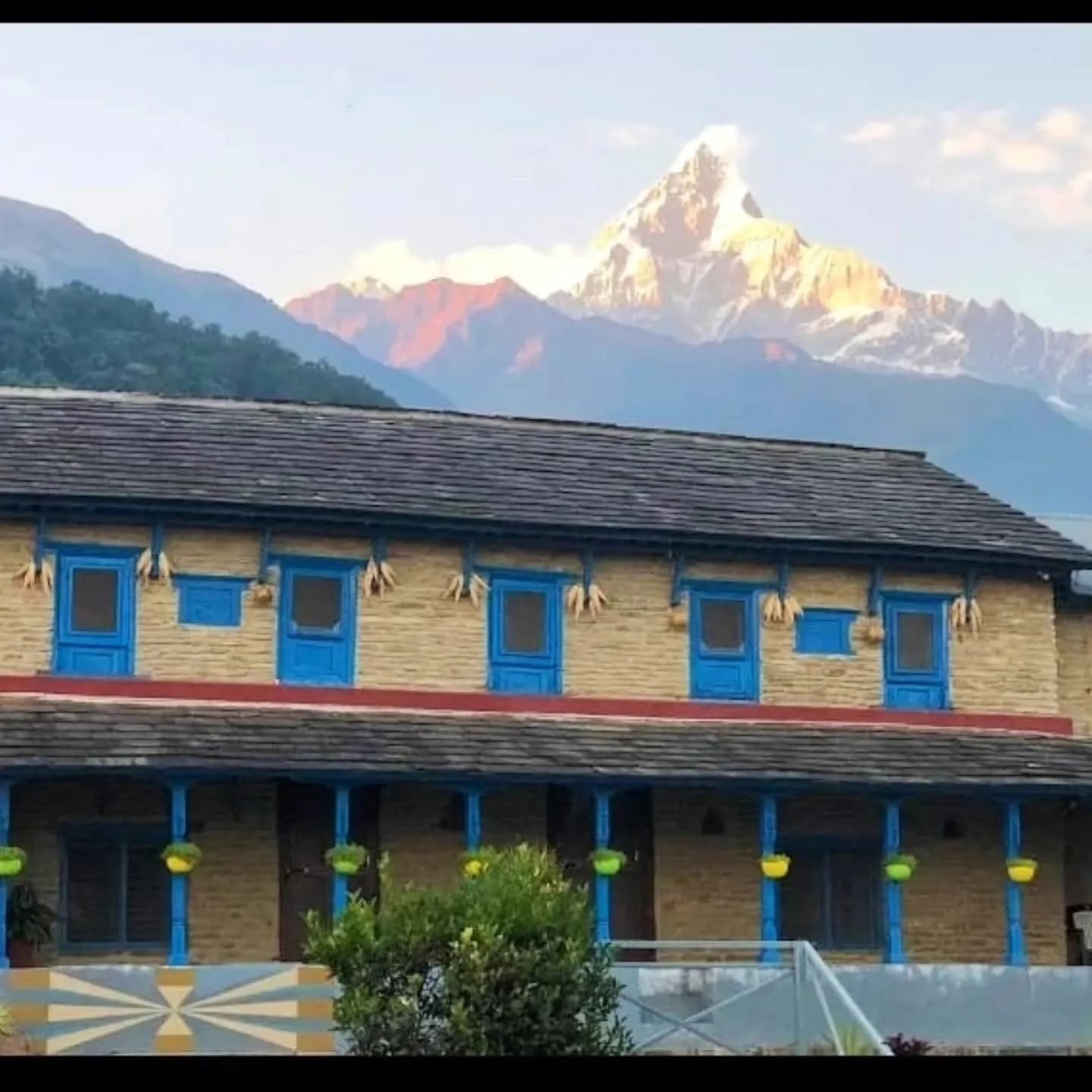
Above Pokhara stands Machhapuchhre, at 6,993 metres. Nepal has refused every climbing permit for it since 1957, because the peak is held to be a home of Shiva.
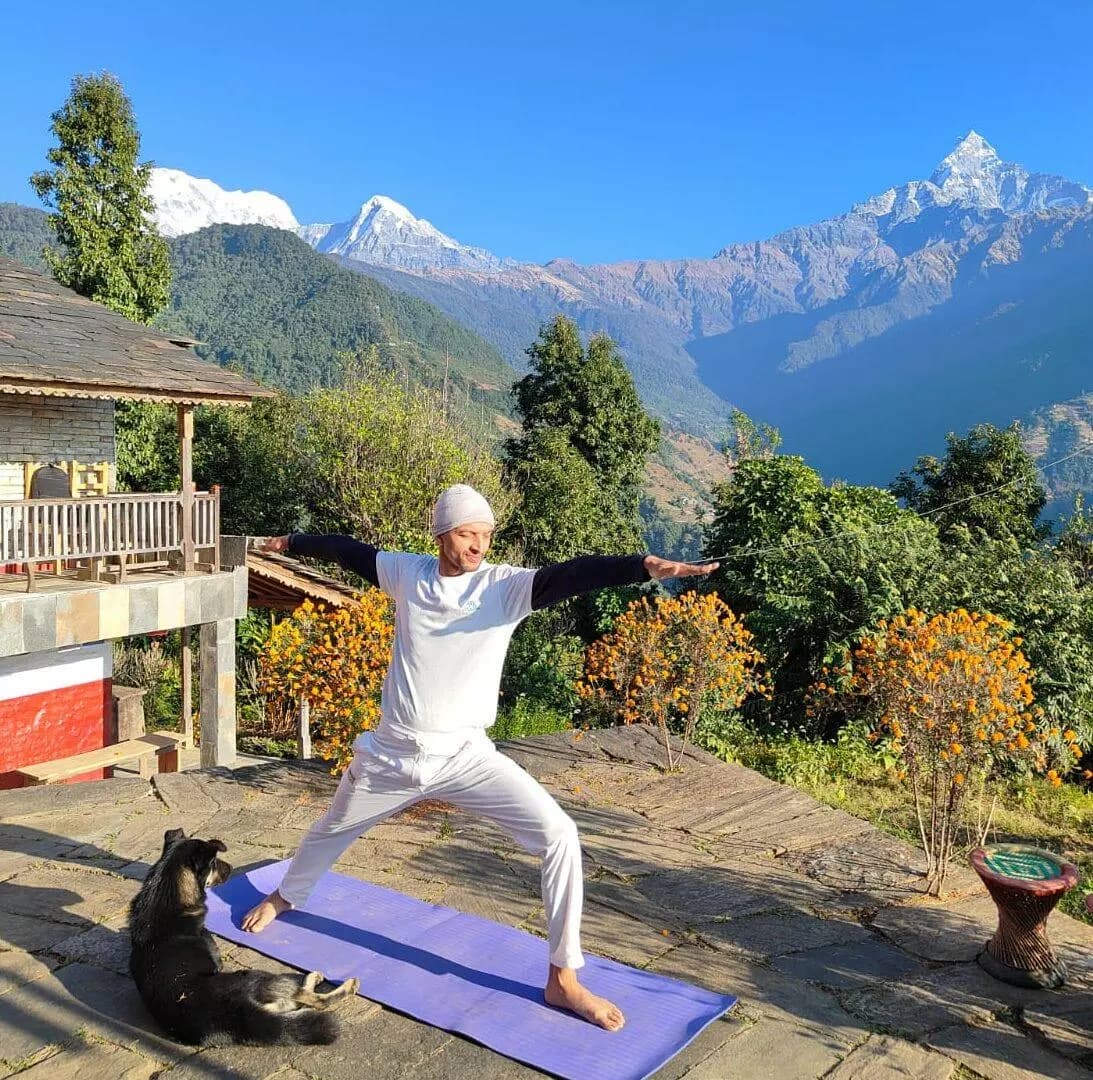
That is the mountain in front of you during morning practice on our Mountain View Yoga and Meditation Retreat.
This is the land of Shiva, and yoga begins with Shiva
The tradition does not trace yoga back to a country. It traces it back to Shiva. In the classical account, Shiva is diyogi, the first yogi, the one who gave the practice to human beings rather than the one who invented it. Everything after that is transmission.
That is a devotional account rather than a historical one, and it is worth saying so gently. What is historical is that Shaiva practice is the ground hatha yoga grew out of. So the question of where yoga comes from becomes a question about where Shiva is held to live, and Nepal has a clear answer to that.
Pashupatinath, and the forest of the deer
The temple on the Bagmati river in Kathmandu is one of the most important Shiva shrines in the world. The name is worth knowing. Pashupati means lord of all living beings, Shiva as the protector of every creature, not only of people. The site has been in religious use for well over a thousand years, and it is one of the seven monument zones in the Kathmandu Valley UNESCO World Heritage listing.
The story of how the shrine came to be there is lovely, and it explains a place name that comes back later in this article.
Shiva is said to have come to the forest of the Kathmandu Valley and liked the stillness so much that he took the form of a deer and stayed, refusing to go back to his duties. When the other gods came to fetch him, one of the deer's horns broke off and fell. That horn became the first linga at Pashupatinath.
The forest is still called Mrigasthali, the place of the deer, and it is still part of the temple grounds today. Remember that name.
One body spread across the Himalaya
There is a second thread in the same tradition. In the Puranic story of the Pandavas following Shiva, he takes the form of a bull, and different parts of the body come to the surface at different Himalayan sites.
Pashupatinath is held to be the head. Doleshwor Mahadev in Bhaktapur is understood as part of the same body. Pilgrims do not think of these as separate temples. They think of them as one body spread across the mountains.
The rest of the Shiva map
| Site | Location | Description |
| Gosaikunda | Langtang, 4,380 m | A lake believed to have formed where Shiva struck the rock with his trident after drinking the poison of the churned ocean. Thousands walk up to bathe at Janai Purnima. |
| Halesi Mahadev | Eastern hills | One of the great Shiva caves of the Himalaya. |
| Muktinath | Mustang, 3,710 m | Features 108 water spouts in the courtyard. |
| Pumdikot | Above Pokhara | A 108-foot-tall Shiva statue with 108 lingas around the base. |
You do not have to visit any of them to have a good retreat. It does change the feel of a place, though, to know that the practice is going on all around you, done by people who are not on holiday and are not being watched.
The Buddha was born here:
The idea that Nepal is the land of the Buddha is not only devotional. It is archaeological, and the evidence is unusually good for something this old.
What the pillar says
Lumbini sits in the southern plains. In 249 BC, the emperor Ashoka travelled there, twenty years after his coronation, and raised a stone pillar to mark the spot. The inscription is in Brahmi script and the Pali language.
It records four things:
- That he came to the place in person
- That he worshipped it as the birthplace of the Buddha Shakyamuni
- That he put up the pillar and a railing
- That he freed the village from tax and cut its grain levy to one eighth
Two traditions, side by side
What this gives a student is two complete traditions of practice living in one small country, with neither having pushed the other out.
It is normal here to practise asana and pranayama in the morning and sit Buddhist breath practice in the evening. Nobody finds that combination strange, because it is how this place has worked for a very long time.
Our Buddha's Teaching Meditation Retreat comes out of that arrangement, and the Noble Silence retreat uses the same combination in silence.
Where the tantric texts were kept alive
This is the part that surprises people, and it is the best documented of everything here.
The oldest surviving Shaiva tantra
Start with the manuscript named at the top of this article.
The Nishvasatattvasamhita is now generally accepted by specialists as probably the oldest surviving complete scripture of the Mantramarga, the main current of tantric Shaivism. It covers cosmology, ritual, initiation and forms of yoga.
The largest manuscript rescue in the region
That manuscript is not an isolated case, and what sits behind it is easy to underestimate.
| Details | Information |
| Ran from | 1970 to 2002 |
| Manuscripts filmed | More than 180,000 |
| Pages filmed | Around five million folios |
| Originals held at | The National Archives of Nepal |
| Second copy held at | The State Library in Berlin |
| Cataloguing continues at | The University of Hamburg |
Among what the project recorded were tantric texts that survive nowhere else in the world, philosophical works previously known only in fragments, and rare Tibetan canonical material.
Why so much of it ended up here
Scholars usually give three reasons.
- The climate. The Kathmandu valley is kind to palm leaf, which decays quickly in wetter heat.
- The practitioners. There was an unbroken community who kept copying the manuscripts because they were still using them, not because they were archiving them. A text stays alive for as long as somebody still needs it on a particular morning.
- The road. The valley sat between the tantric centres of the north west and the Buddhist world of Tibet, so material moved through in both directions, and some of it stayed.
The living side of Nepal that makes it the best destination for yoga
Newar Buddhism in the Kathmandu valley is a form of Vajrayana with its own character, built around a non-monastic sangha, and it kept its Sanskrit. It is widely described as a rare surviving continuation of Indic tantric Buddhism, with hundreds of Sanskrit and Newari manuscripts, rituals and institutions still in use. Not rebuilt afterwards, but carried on.
Then there is Maratika, the cave at Halesi in Khotang district in the eastern hills. It is the place where Padmasambhava and his consort Mandarava are said to have accomplished the practice of Amitayus and attained deathless life, before he travelled north to Tibet in the eighth century. Tibetan Buddhism counts it among the most sacred places in the world. The same cave complex is a major Shiva site for Hindus, and both traditions use it without anyone finding that unusual.
So when teachers here say that tantra yoga was practised in Nepal, it is not a claim about atmosphere. It is a claim about manuscripts, caves and unbroken lines of ritual, and it can be checked in a university library.
The founders of hatha yoga, and where their seats are
Anyone who practises postures, locks, breath retention or the cleansing techniques is working inside a tradition with a source. That source is the Nath order, and the Nath order has two founding figures.
Matsyendranath is the founder of the Nath sampradaya and one of the eighty-four mahasiddhas. Gorakhnath is his disciple. Between them, these two stand at the head of the tradition that produced hatha yoga, and the two foundational manuals of the practice, the Hatha Yoga Pradipika and the Gheranda Samhita, come out of their world.
Nepal treats yoga as its own, on paper as well as in practice
This part is administrative and unromantic, but it is useful because you can look it up.
| Details | Information |
| National Yoga Day | Magh 1, mid-January. Marked since 1980 and formally declared in 2015 |
| International Yoga Day | 21 June. Pokhara hosts one of the country's largest gatherings |
| University Study | Nepal Sanskrit University teaches yoga and naturopathy. Tribhuvan University added a postgraduate diploma in Yoga Science in 2019 and a master's degree in 2020 |
| Ayurveda Regulation | The Nepal Ayurvedic Medical Council has existed since 1988, and Ayurveda is taught to degree level |
| Public Ayurveda | The Central Ayurveda Hospital at Naradevi, Kathmandu, opened as a dispensary in 1917 and is now the teaching hospital for Tribhuvan University's Ayurveda programme |
Our Ayurveda Healing Retreat works inside that system, starting with a dosha consultation rather than a menu of treatments.
What this actually changes for you
Now the honest part, because everything above is history, and a student needs to know what it means on an ordinary Tuesday morning.
What it does not do
None of this makes you a better practitioner on its own. Standing near a sacred mountain does not deepen your practice. Being in the country where a text survived does not pass the text to you. Practice does that, and practice is the same everywhere.
What it does do
The conditions are right. Cold mornings, real darkness, thin clean air, no traffic, and nothing being sold to you on the walk to the shala. Brahma muhurta, the hour and a half before sunrise that the texts call the best time to practise, is an instruction most people cannot follow at home. Here it is simply what the day does. After three mornings you stop taking the instruction on trust. Our piece on the best time for meditation explains why that hour was chosen.
Both traditions are available. You can sit yogic practice and Buddhist practice in the same week, with teachers who do not treat that as a contradiction, because here it never was one.
The setting is alive rather than arranged. The village around you is farming. The shrine on the path is in use. Nothing is being performed for your benefit, which is part of why it affects you.
What matters more than the setting
Altitude on its own does not do very much, and a mountain view is not a lineage. What decides how much you get out of a stay is who is standing in front of you at half past five in the morning.
So the question worth asking any school, including this one, is a simple one. Who taught the person who is going to teach you, where did they train, and for how long? After that, look at the practical things.
- Whether the course is residential
- How many students are in a group
- Whether the same teacher takes you the whole way through
- Whether the kitchen understands the practice
If you are working out how much training to do while you are here, our guide to choosing between 100, 200 and 300 hours walks through who each level suits.
Where in Nepal, and when to come
The three places
Kathmandu is where you land, and where the sacred sites are densest. Pashupatinath, Mrigasthali and the Gorakhnath seat, Boudhanath, Swayambhunath, and the Rato Machhindranath temple in Patan. Two or three days at the start or end of a trip is usually enough.
Pokhara is where most retreats and teacher trainings run. It sits at 822 metres under the Annapurna range. Inside Pokhara, there is a real difference between the lakeside town, which is busy and full of restaurants, and the hill villages above it, which are not. Our own ashram is at Ghachowk at 1,320 metres, about thirty minutes above the town, which gives you Kathmandu's altitude with Pokhara's air.
Lumbini is for Buddhist practice in particular, and is a long day's travel from Pokhara.
The seasons
| Months | What to Expect |
| October and November | The best of the year. Air washed clean by the monsoon, mountains out, and days around 15–25°C |
| March to May | The other good window. Settled weather and rhododendrons on the higher slopes |
| December to February | Cold mornings, very quiet, and lovely visibility in January |
| June to September | Monsoon. Peaks can stay behind clouds for weeks, but it is the greenest and emptiest time, and often the best-priced |
There is a fuller breakdown in our guide to [the best time for a yoga retreat in Nepal](https://bodhidham.com/blog/best-time-for-a-yoga-retreat-in-nepal).
The visa
Most nationalities get one on arrival. You need a passport valid for six months and a photo.
If you would like the mountains as part of the practice rather than a view from the window, the yoga treks walk in the day and practise at either end of it. If you would like a full season rather than a fortnight, the long term retreat runs from one to three months. Everything else, from three days upward, is in the retreats and the teacher training courses.
Frequently asked questions
- Why practise yoga in Nepal?
Because it is one of the places the tradition came from in its own right. The founders of the Nath line that produced hatha yoga have their seats and festivals here. The oldest surviving Shaiva tantra exists in a ninth-century Nepalese manuscript. The Buddha was born here. On top of that history sit the practical conditions the practice was built around: mountains, clean cool air, quiet villages, early dark nights, and a tradition that carried on without interruption.
2. Is it true that yoga comes from Shiva?
In the tradition, yes. Shiva is Adiyogi, the first yogi, who gave the practice to human beings rather than inventing it. This is a devotional and traditional account rather than a historical one, and it is worth being clear about the difference. What is historical is that Shaiva practice is the soil hatha yoga grew out of, and that Nepal holds some of the most important Shiva sites anywhere, including Pashupatinath, which pilgrims understand as the head of a divine body spread across the Himalaya.
3. What does it mean that Nepal is the land of the Buddha?
The Buddha was born at Lumbini in southern Nepal. This is not only tradition. The emperor Ashoka visited in 249 BC, raised a stone pillar and cut an inscription into it in Brahmi script naming the site as the Buddha's birthplace. That inscription is the earliest written evidence anywhere for where he was born. The pillar was found again in 1896 and still stands, and Lumbini has been a UNESCO World Heritage site since 1997.
4. Was tantra really practised in Nepal?
Yes, and the documentary evidence is unusually good. The Nishvasatattvasamhita, generally accepted as the oldest surviving complete tantric Shaiva scripture, reaches us through a ninth-century Nepalese palm leaf manuscript, and its critical edition was produced by an international team that included two Nepali scholars. The Nepal German Manuscript Preservation Project microfilmed over 180,000 manuscripts here between 1970 and 2002, including tantric texts that survive nowhere else. Newar Vajrayana Buddhism in the Kathmandu valley is a living Sanskrit-based tantric tradition rather than a rebuilt one.
5. What is the connection between Nepal and the founders of hatha yoga?
Matsyendranath, founder of the Nath order, is worshipped in Patan as Rato Machhindranath and has one of the longest chariot festivals in the country. Gorakhnath, his disciple and the figure most associated with the rise of hatha yoga, has his meditation seat at Mrigasthali inside the Pashupatinath grounds. The district of Gorkha takes its name from him, as does the word Gorkhali. Their stories, seats and festivals are set in this country and are still alive in it.
6. Do I need experience to come?
No. Beginners are the normal case rather than the exception. Traditional hatha is slow, with postures held rather than flowed, and there is no flexibility or fitness requirement to start. What is asked is that you keep the daily schedule, which for most people is harder than any posture.
7. Where in Nepal should I go for a retreat or teacher training?
Pokhara for most retreats and trainings, because it combines the mountains with genuine quiet and is easy to reach. Kathmandu for the sacred sites, and worth a few days at either end of a trip. Lumbini for Buddhist practice in particular. Within Pokhara, there is a real difference between the lakeside town and the hill villages above it, and the villages suit practice far better.
8. When is the best time of year to come?
October and November are the clearest and most comfortable months, with the mountains fully out after the monsoon. March to May is the other good window. January is cold in the mornings but has lovely visibility. June to September is the monsoon, when the peaks are usually hidden, and the rain is heavy, although it is also the greenest, quietest and often the best priced time.
What is rare is a place where all of this is still ordinary. Where the mountains the texts describe are the ones outside the window. Where the manuscript survived because somebody kept copying it, and somebody kept copying it because they were still using it. Where the man walking past at five in the morning with a shawl over his head is going somewhere to sit, and has been for forty years, and nobody thinks that is remarkable.
That is what Swami Ananda means when he says Nepal has been a stronghold of practitioners for thousands of years. Something that never had to be brought back, because it never left.