Almost everybody who decides to travel for yoga ends up looking at the same three places.
- India, because that is where the tradition comes from.
- Bali, because it has become one of the great gathering places for practice.
- And Nepal, because it sits in the middle of the Himalaya with a history of its own.
They are all good choices. That is the first thing worth saying, because a lot of what is written about this reads like an argument, and it is not one. These are three different experiences rather than three grades of the same experience, and the useful question is not which is best. It is which of the three suits the person you are right now.
This article describes each one honestly, then gives you a simple way to decide.
India, and the Ganga at Rishikesh
India is where yoga comes from, and Rishikesh is where most people go when they want to practise there.
The town sits on the banks of the Ganga, in the foothills of the Himalaya, where the river comes down out of the mountains. For Hindus, the Ganga is the holiest river there is, and a great deal of what Rishikesh feels like comes from being beside it.
What it is like
The town has more yoga schools and ashrams than almost anywhere on earth. Parmarth Niketan, the Sivananda ashram, Swarg Ashram and many others sit along the river, most of them offering daily classes, discourses and satsang. Between them you can find almost every branch of the practice being taught. Hatha, kundalini, kriya, breathwork, meditation and mantra.
Every evening there is the Ganga Aarti, when hundreds of people gather on the ghats with lamps and chanting as the light goes. Most visitors describe it as the thing they remember longest.
Rishikesh is also vegetarian and alcohol free by long custom, which many students find helps a great deal in the first week.
Who it suits
Rishikesh suits somebody who wants to be at the source, and who wants choice. If you like the idea of being able to try several teachers, sit in on different traditions, and be surrounded by other practitioners doing the same thing, this is the place with the deepest bench.
It also suits a student who wants the devotional side of yoga rather than only the physical side. The Aarti, the temples, the river and the sadhus are not on the edges of the experience there. They are the experience.
Bali, and the valleys around Ubud
Bali has become one of the world's best-known places to practise, and Ubud is its centre.
Ubud sits inland, away from the beaches, among rice terraces and jungle valleys. It holds a concentration of studios, retreat centres and teachers that few places anywhere can match, and it has been building that for decades.
What it is like
Balinese Hindu culture runs through ordinary daily life on the island. Offerings are laid out every morning at doorways and shrines. Ceremony is not something arranged for visitors, it is simply what is happening, and most guests notice the effect of that within a day or two.
Retreats there often bring in Balinese practices alongside the yoga. Purification ceremonies, herbal baths, healing work and blessings. Many also build in cooking, craft and local food. The Bali Spirit Festival each May draws practitioners from around the world.
The other thing Bali offers is ease. Comfortable places to stay, very good food, warm weather, and everything set up for a visitor who has flown a long way.
Who it suits
Bali suits somebody who wants their practice to sit inside a comfortable and beautiful trip. If it is your first time travelling alone, or your first long journey, it is one of the gentlest places in the world to arrive.
It also suits people who want the wellness side alongside the yoga. The healing work, the food, the treatments and the social side of it are all part of what you are going for, and Ubud does that as well as anywhere.
Nepal, and the Himalayan hills
Nepal is the quietest of the three, and the least busy.
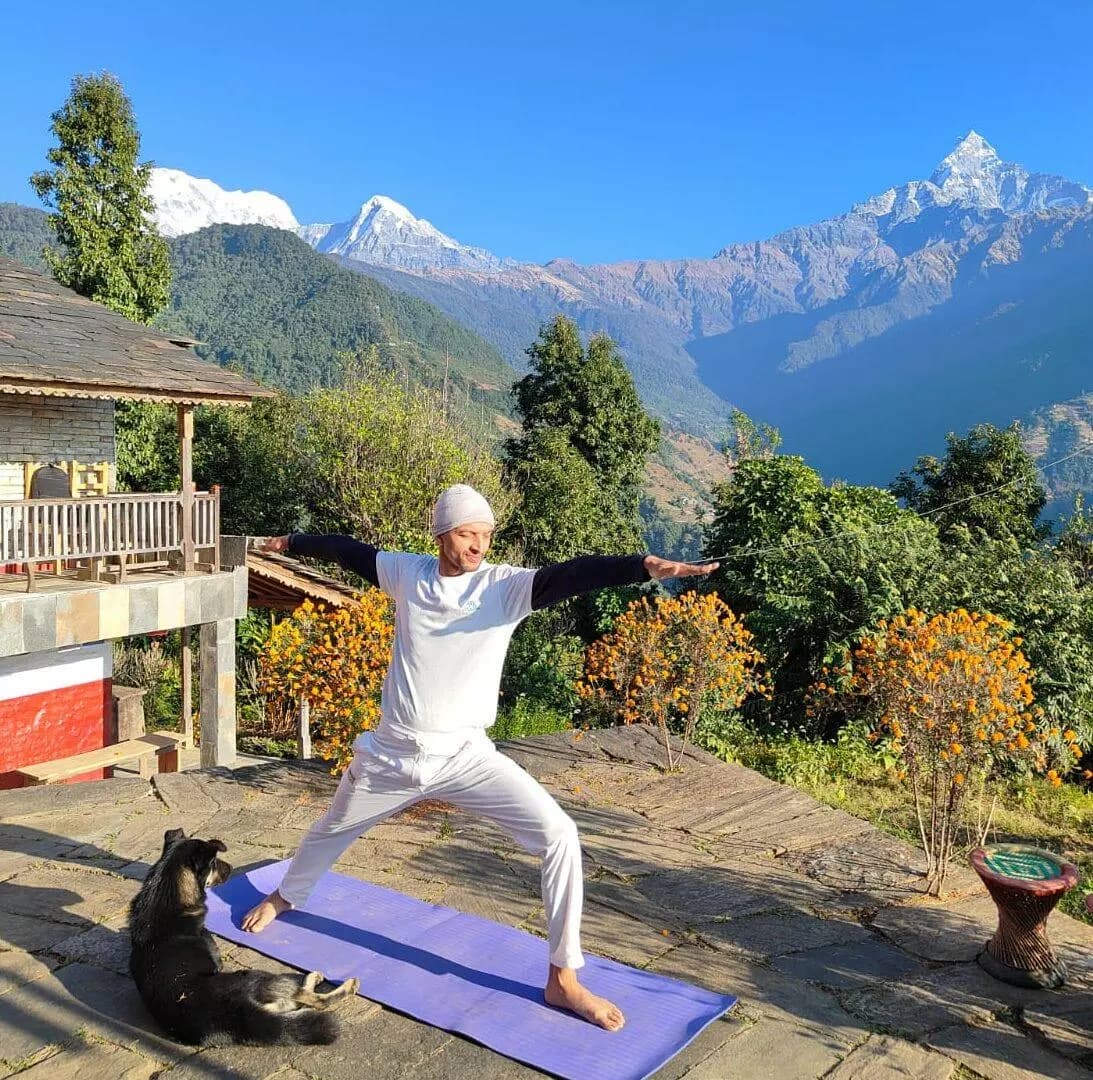
The country sits along the Himalaya, with eight of the world's fourteen mountains above 8,000 metres inside its borders. Most retreats and teacher trainings run near Pokhara, under the Annapurna range, though Kathmandu holds the greatest number of sacred sites.
What it is like
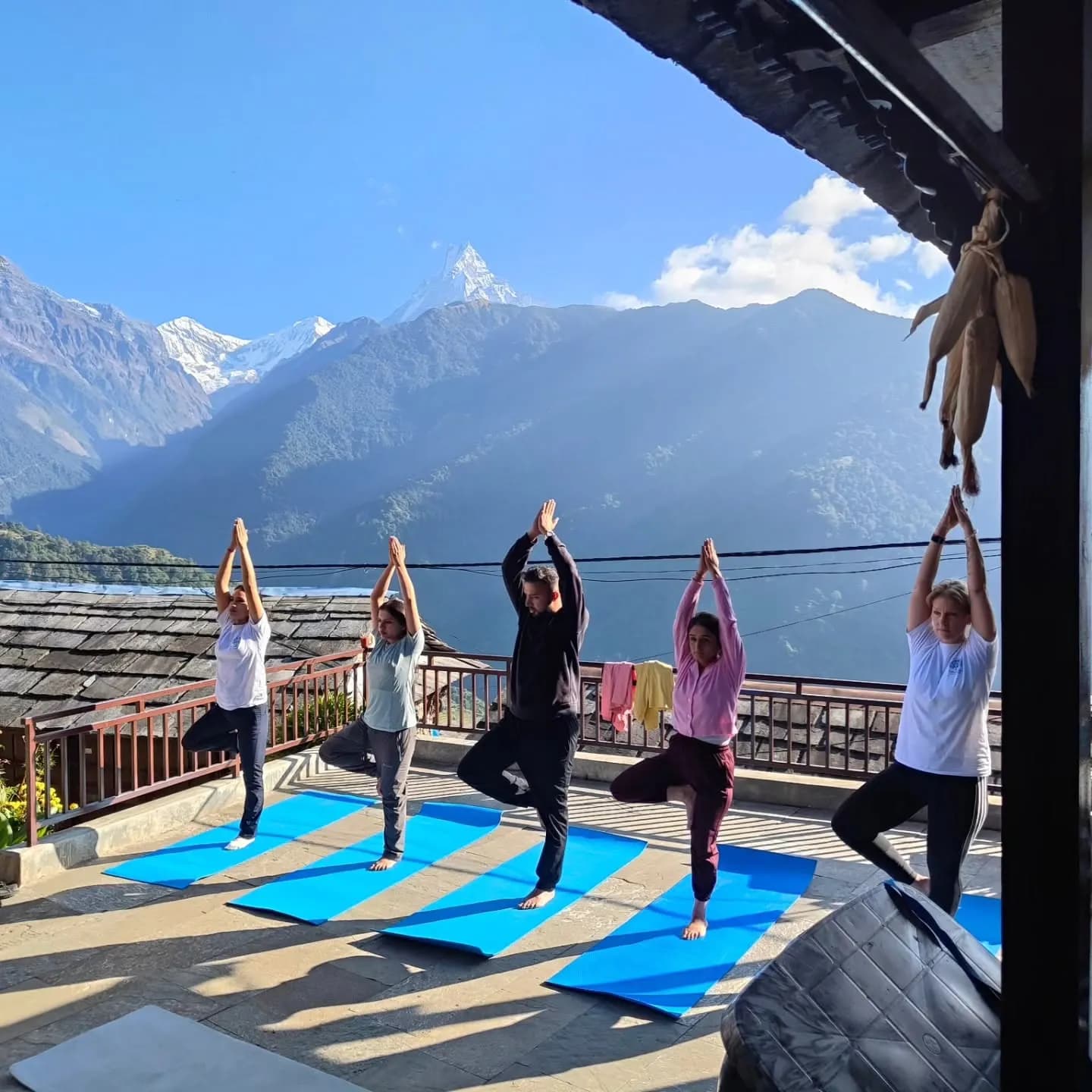
Groups tend to be small. That is partly because the yoga scene here is younger, and partly because many of the schools are residential ashrams rather than centres, so numbers are limited by the size of the building.
The tradition here has its own roots rather than borrowed ones. The oldest surviving complete Shaiva tantra reaches the world through a ninth-century manuscript from Nepal. The Buddha was born at Lumbini in the south of the country. The founders of the Nath order, which produced hatha yoga, have their seats and festivals here, and Matsyendranath is still carried through the streets of Patan every year as a living deity.
Then there is the geography. The air in the hills is cool, clean and slightly thin, which most students notice in their breathing within a few days. And the mountains are close enough that many people finish a course and walk into the Annapurnas the same week, which is not something the other two can offer.
You can read more about that history in our piece on why yoga in Nepal, and about the walking side in yoga and trekking.
Who it suits
Nepal suits somebody who wants quiet and wants to be known.
If the idea of a group of forty appeals less than a group of eight, if you would rather have the same teacher every day than a rotating timetable, and if you want mornings that are genuinely cold and dark and silent, this is the one.
It also suits people who want to combine practice with the mountains, and people who like the idea of a tradition that never had a gap in it.
The three side by side
| India | Bali | Nepal | |
| The centre | Rishikesh, on the Ganga | Ubud, inland among rice terraces | Pokhara and the Annapurna foothills |
| The feeling | Devotional and busy, at the source | Warm, comfortable and social | Quiet, cold in the mornings, close to the mountains |
| Group sizes | Often large, with a wide choice of schools | Varies, many centres and studios | Usually small, often residential ashrams |
| What surrounds you | Temples, ghats, the river, sadhus | Ceremony, offerings, jungle and rice fields | Villages, shrines, farms and high peaks |
| Something particular | The Ganga Aarti every evening | Balinese healing practices woven in | Trekking straight from the course |
None of those columns is a score. They are simply three different weeks.
How to actually decide
Forget the three countries for a moment. Four questions will settle it faster than any comparison will.
1. What do you want more of when you get home?
- If the answer is knowledge and choice, go where the schools are thickest.
- If the answer is rest and comfort, go where the living is easiest.
- If the answer is a practice that has become a habit, go where the days are quiet, and the group is small enough that nobody can drift.
2. How much noise can you handle while you practise?
This is the question people underestimate most. Some students are lifted by being surrounded by hundreds of other practitioners. Others find that after a week they cannot hear themselves.
Be honest about which one you are, because it will decide more of your experience than the syllabus will.
3. Do you want the tradition in the foreground or the background?
In some places the ceremony, the chanting and the temples are the centre of the day. In others they are gently present, and you can take them or leave them.
Neither is better. But arriving expecting one and finding the other is the most common reason people come home disappointed.
4. What are you doing either side of the course?
A training does not exist on its own. It sits inside a trip.
If you want beaches and easy travel afterwards, that points one way. If you want to walk in high mountains afterwards, that points another. If you want to visit temples and old cities, that points somewhere else again.
What is the same wherever you go
It is worth saying plainly that the important part does not change with the country.
- The teacher decides your experience. Not the setting, not the view, not the price. Who is standing in front of you at half past five in the morning is the single biggest factor in what you take home, in all three places.
- The practice is the same practice. A sun salutation in Ubud is a sun salutation in Rishikesh and in Ghachowk. What changes is the air around it and the company you are in.
- Discipline travels with you. No country makes you practise. The people who get the most out of a month away are the ones who would have practised at home too, and the place simply removed the excuses.
- Small print matters more than atmosphere. Whether the course is residential, how many students are in a group, whether the same teacher takes you the whole way through, and what is actually included in the fee. Those four things will shape your month more than anything on a brochure.
- So the question worth asking any school, in any of the three countries, is the same one. Who taught the person who is going to teach you, where did they train, and for how long. A school in a real line will answer that without hesitating.
If you are also working out how long to train for, our guide to choosing between 100, 200 and 300 hours walks through who each level suits.
A word about cost
Fees vary quite a lot across the three, and it is easy to compare the wrong numbers.
Two courses with the same headline price can be very different once you look at what is inside it. Some fees include accommodation, all meals, materials and airport pickup. Others cover tuition only, and the room, the food and the transfers arrive as separate bills after you have already booked.
So the useful comparison is not the fee. It is the fee plus the room, plus the meals, plus the transfers, plus your flights and visa, divided by the number of days. That number often looks very different from the one on the website.
Ask any school for the all-in figure in writing before you pay a deposit. A school that gives it to you plainly is telling you something about how the rest of the course will be run.
Frequently asked questions
- Is one of these three better than the others?
No, and anyone who tells you otherwise is probably selling one of them. They are genuinely different experiences. India offers the greatest depth and choice and the strongest devotional atmosphere. Bali offers comfort, beauty, and a very well-developed wellness culture. Nepal offers quiet, small groups, mountains and a tradition that was never interrupted. The right one depends on what you are actually looking for.
2. Which one is best for a complete beginner?
All three take beginners, and all three do it well. What matters more than the country is the group size and the style. A beginner usually does better in a small group with a gentle traditional style, where the teacher can see everybody in the room, than in a large group with a fast pace, wherever that group happens to be.
3. Which one is easiest for a first solo trip?
Nepal is also manageable, particularly if the school collects you from the airport, which many do. India rewards a little more travel experience, though thousands of first-time travellers do it every year without trouble.
4. I want to do a teacher training. Does the country affect the certificate?
Not usually. What matters is whether the school is registered with Yoga Alliance, not which country it sits in. Registered schools in all three places issue the same recognised certificate. Always check the school's registration rather than assuming, because not every course that looks like a teacher training is one.
5. Can I combine the training with trekking?
This is the one place where geography genuinely decides it. Nepal puts you inside the Himalaya, so it is common to finish a course and walk the Annapurna or Poon Hill routes in the days afterwards. India offers hill walking around Rishikesh and further north with more travel involved. Bali is an island, so the walking is volcano hikes and rice terrace paths rather than high mountains.
6. What about the weather?
Bali is warm all year, with a wetter season roughly from November to March. Rishikesh is hot in summer and pleasant from autumn to spring. Nepal has two clear windows, October to November and March to May, when the mountains are out and the days are mild. Our month-by-month guide to Nepal has the full picture for here.
8. What if I have never stayed at an ashram before?
That describes most people. Our piece on your first week at an ashram walks through what daily life is actually like, from the early start to the shared meals, and it applies fairly well wherever you go.
One last thought
You will hear people say that one of these three is the real one and the others are for tourists. It is not true, and it is usually said by somebody who has only been to one of them.
India carries the source and the greatest depth of teaching. Bali carries warmth and a culture that lives its ceremony every single day. Nepal carries the mountains, the quiet, and a line of practice that never had a break in it.
Pick the one that matches the week you actually want, ask the school the questions above, and then do the practice. That last part is the same everywhere, and it is the part that decides what you bring home.
If Nepal sounds like the one, our retreats run from three days upward, and our teacher training courses run through the year, in a village at 1,320 metres, about thirty minutes above Pokhara.