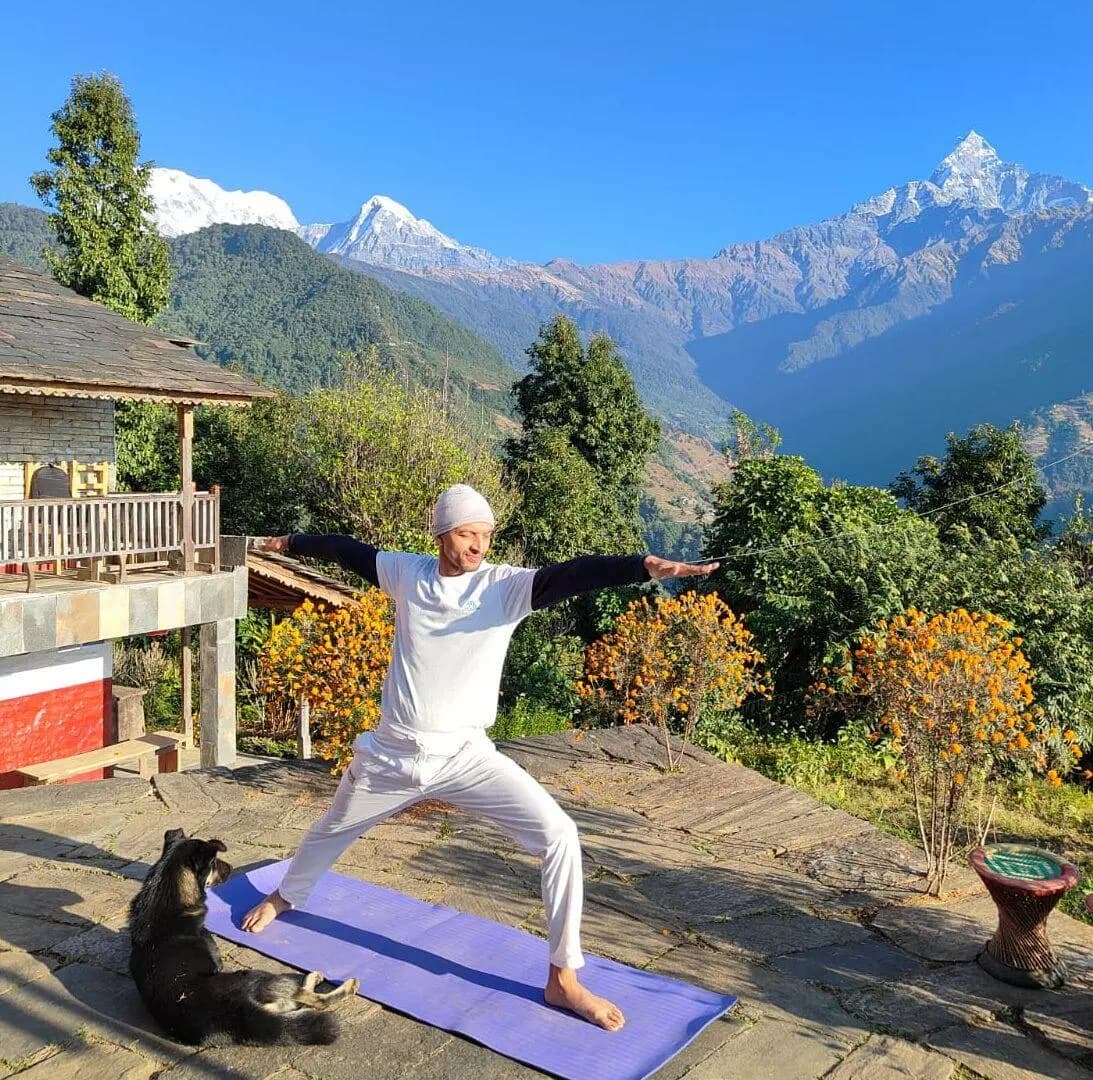

A 5-minute warm-up before you walk and 10 minutes of stretches after, the routine we use on our Mardi Himal and Poon Hill yoga treks.
Yoga for hikers comes down to two short routines: a five-minute warm-up before you set off, and ten minutes of slower stretches once you stop for the day. The warm-up wakes up your ankles, hips and spine. The stretches afterwards release the calves, hamstrings, hip flexors and glutes that do most of the work on a climb or a long descent.
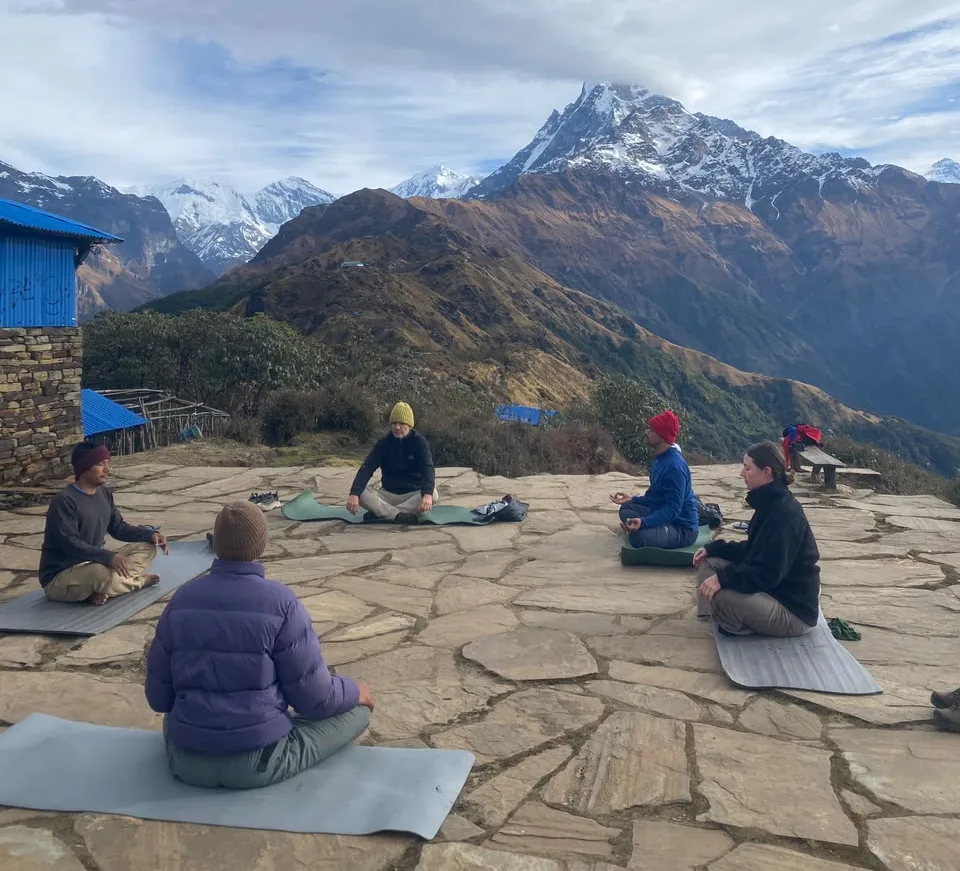
This is the pattern we follow on our Mardi Himal Yoga Trek and Poon Hill Yoga Trek in the Annapurna region: a short practice in the morning before walking, and a quieter one in the evening at the teahouse. It works just as well on a day hike at home.
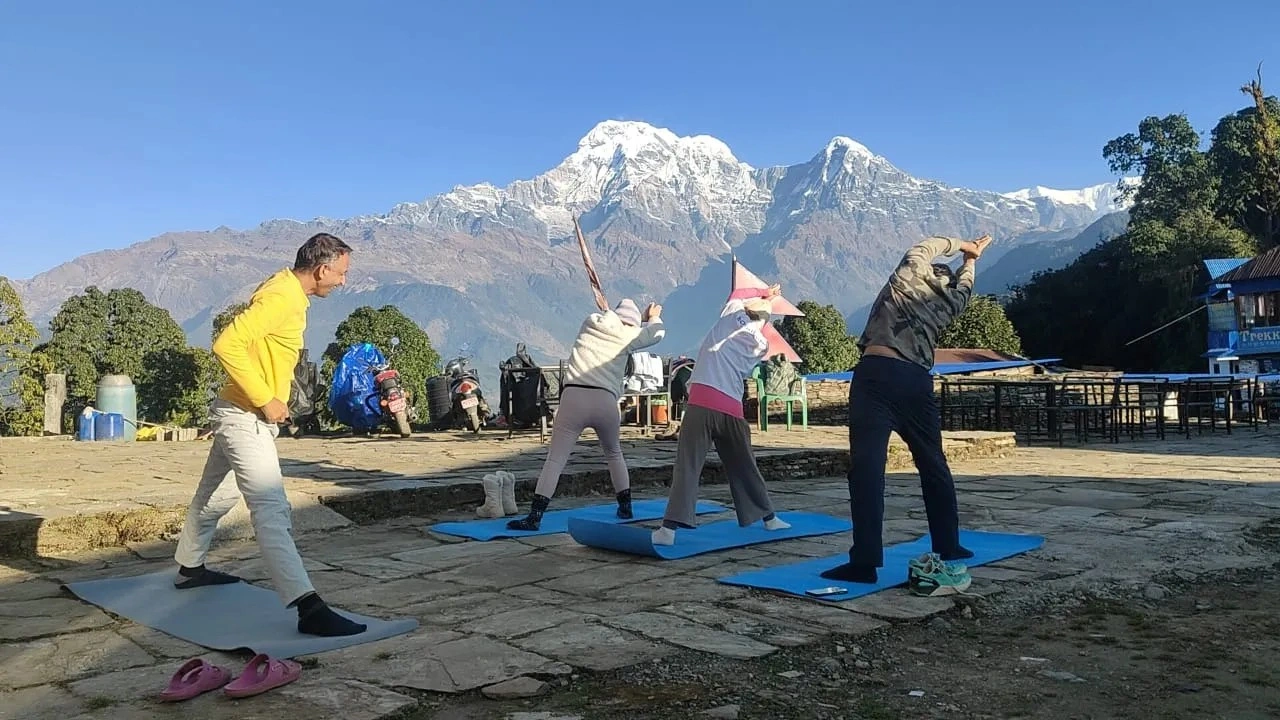
The routine at a glance
Before you walk (about 5 minutes). Hold each pose for 3 to 5 breaths, or move with the breath.
- Mountain pose with arm raises (Tadasana)
- Standing side bend
- Cat and cow (Marjaryasana and Bitilasana)
- Low lunge (Anjaneyasana)
- Warrior II (Virabhadrasana II)
- Tree pose (Vrksasana)
After you walk (about 10 minutes). Hold each pose for 5 to 10 slow breaths.
- Standing forward fold (Uttanasana)
- Downward-facing dog (Adho Mukha Svanasana)
- Low lunge with a quad stretch
- Reclined figure four (Supta Kapotasana)
- Wide-legged forward fold (Prasarita Padottanasana)
- Legs up the wall (Viparita Karani)
You do not need a mat. Most of the warm-up is done standing, and for the floor poses a folded jacket or a patch of flat grass is enough.
Before you walk: a 5-minute warm-up
Keep this part gentle. Muscles are cold at six in the morning in a mountain village, so save the long holds for the evening. Move slowly, breathe through the nose, and keep every pose easy.
1. Mountain pose with arm raises (Tadasana)
Stand with your feet hip-width apart and your weight spread evenly through both feet. As you breathe in, sweep your arms out to the sides and up over your head. As you breathe out, lower them back down. Repeat five times.
Why it helps: it sets your posture before you put on a pack, and lengthens the body after a night curled up in a sleeping bag.
2. Standing side bend
From mountain pose, raise both arms overhead and hold your left wrist with your right hand. Breathing out, lean gently to the right, keeping both feet grounded and your hips level. Stay for 3 breaths, come back to centre, and repeat on the other side.
Why it helps: it opens the sides of the ribs, where the hip belt and shoulder straps sit, and makes it easier to take a full breath.
3. Cat and cow (Marjaryasana and Bitilasana)
Come onto your hands and knees, wrists under shoulders and knees under hips. As you breathe in, let the belly drop and lift the chest and gaze (cow). As you breathe out, round your back and tuck your chin (cat). Do five slow rounds. On a cold or wet morning, do it standing instead: hands on your thighs, knees soft, the same movement of the spine.
Why it helps: it moves the whole spine before hours of carrying a pack.
4. Low lunge (Anjaneyasana)
Step your right foot forward and lower your left knee to the ground, with a jacket under it for padding. Keep the front knee over the ankle. Lift your chest and let your hips sink forward until you feel a stretch at the front of the left hip. Stay for 3 to 5 breaths, then switch sides.
Why it helps: the hip flexors tighten on long climbs and stone staircases, such as the long flight of steps up to Ulleri on the Poon Hill trail.
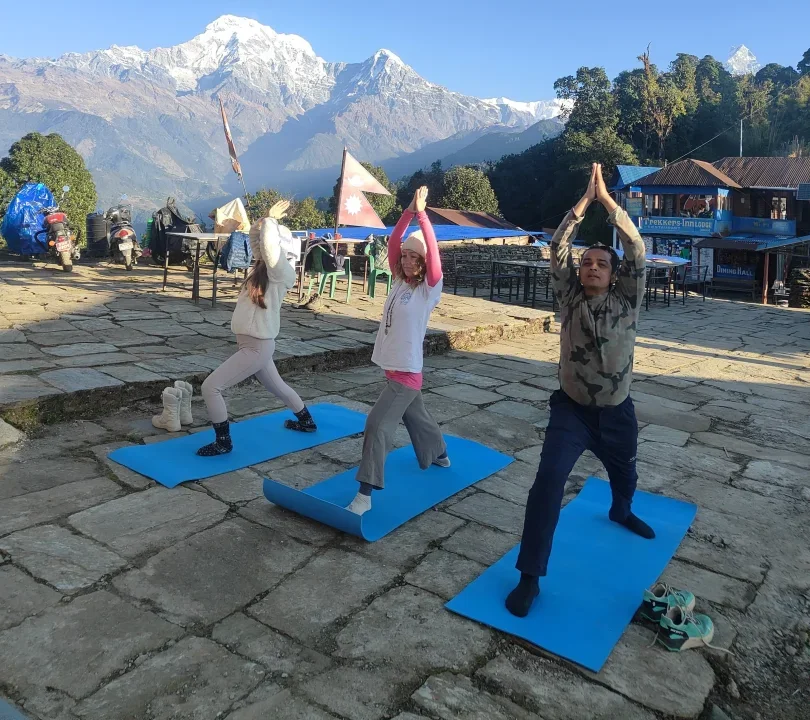
For a stronger version, lift the back knee off the ground and raise both arms overhead into a high lunge, as in the photo below.
5. Warrior II (Virabhadrasana II)
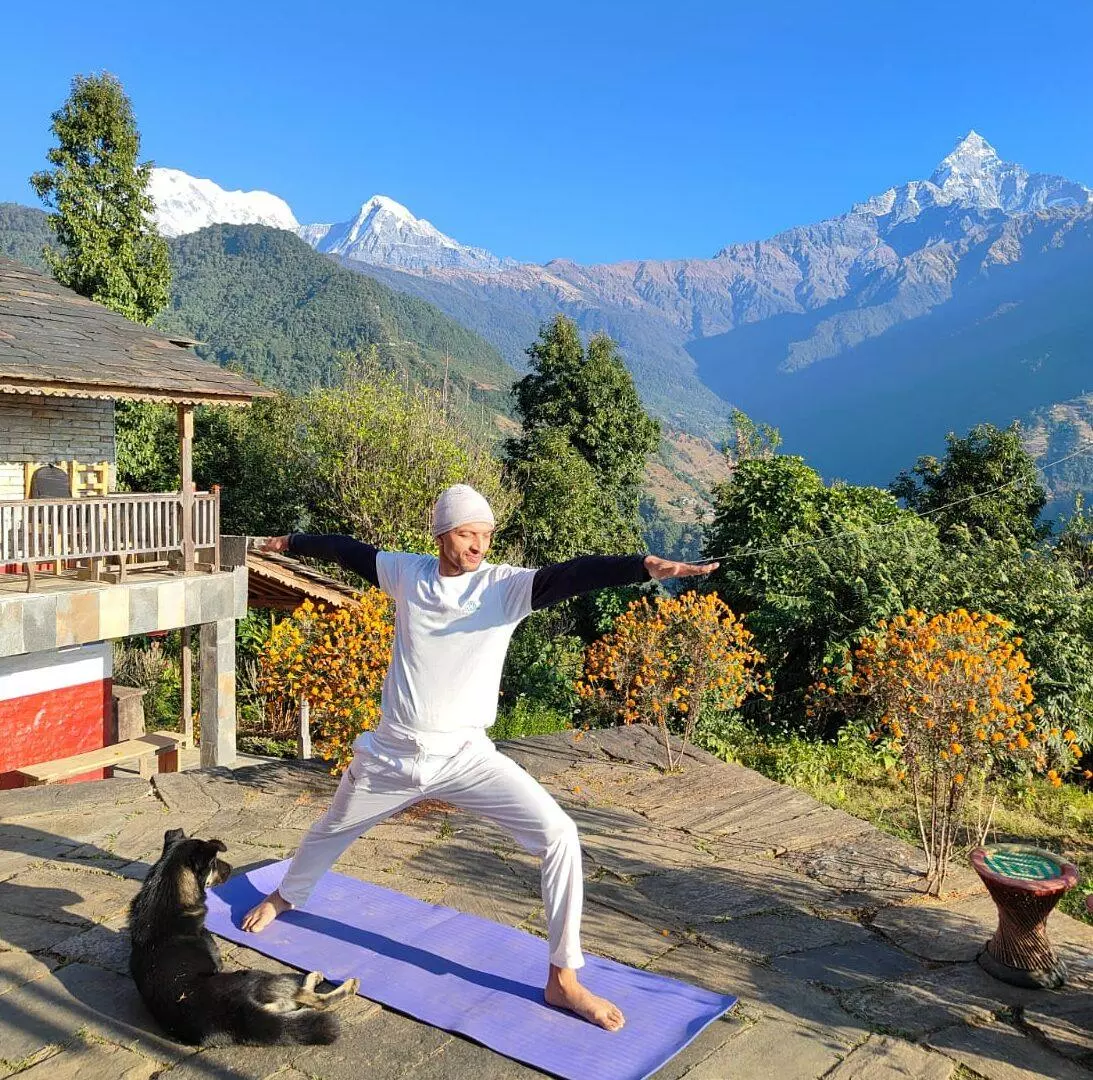
Step your feet wide apart. Turn your right foot out and your left toes in slightly. Bend your right knee until it sits over the right ankle, with the knee pointing towards your second toe. Reach your arms out at shoulder height and look past your right hand. Stay for 3 to 5 breaths on each side.
Why it helps: it wakes up the thighs and glutes that carry you uphill, and trains the knee to track over the foot, which you will want on the way down.
6. Tree pose (Vrksasana)
Stand on your left foot. Place the sole of your right foot on your inner left calf or inner thigh, avoiding the knee joint itself. Bring your palms together at your chest or raise them overhead. Fix your gaze on one still point. Stay for 3 to 5 breaths, then switch legs.
Why it helps: balancing on one leg prepares your ankles and feet for uneven ground, loose stones and tree roots.
If you have a few more minutes, add two or three slow rounds of Surya Namaskar. It links most of these movements into one flowing sequence.
After you walk: 10 minutes of post-hike stretches
Do these once you have arrived, changed into dry layers and had something warm to drink. Your muscles are warm now, so this is the time for longer holds. Stretch to a mild pull and stop short of pain.
1. Standing forward fold (Uttanasana)
Stand with your feet hip-width apart, bend your knees generously and fold forward from the hips. Let your head and arms hang. Slowly straighten your legs as far as is comfortable. Stay for 5 to 10 breaths, then roll up slowly with your head coming up last.
Releases: hamstrings, calves and the lower back.
2. Downward-facing dog (Adho Mukha Svanasana)
From hands and knees, tuck your toes and lift your hips up and back so your body makes an upside-down V. Keep your knees bent at first. Pedal your feet, bending one knee and then the other, to work into each calf. Stay for 5 to 10 breaths.
Releases: calves and Achilles tendons, which work hard on steep descents, and the shoulders after a day under a pack.
3. Low lunge with a quad stretch
Come back into the low lunge from the morning, left knee down. If that feels fine, bend your back knee and reach back with your left hand to hold the foot, drawing the heel towards your buttock. Keep the front knee over the ankle. Stay for 5 breaths, then switch sides.
Releases: the hip flexors and the front of the thighs, which take the braking load on every downhill step.
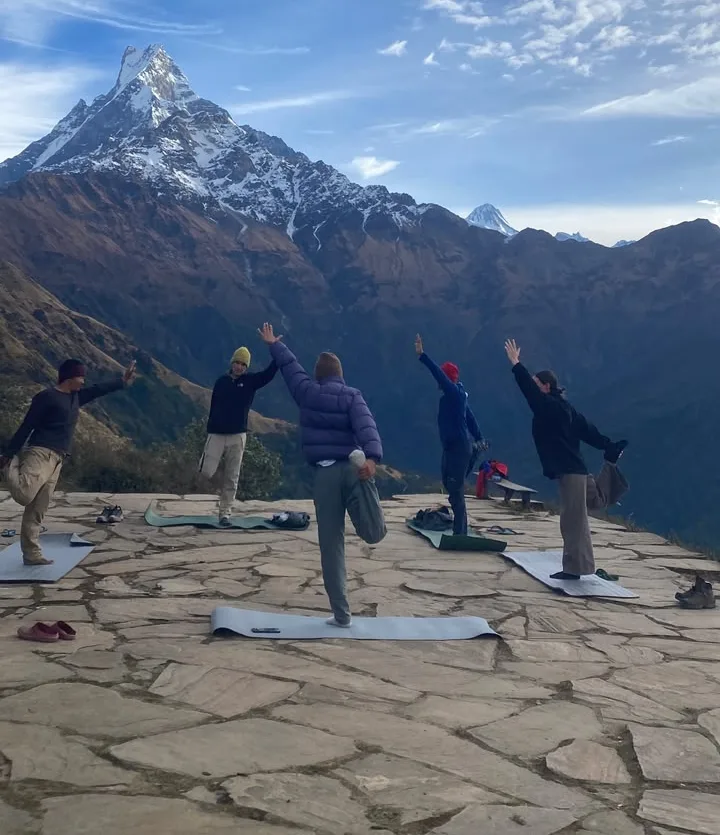
On a stone terrace or wet grass you can do the quad stretch standing instead. Balance on one leg, hold the other foot behind you and draw the heel towards your buttock, with a hand on a wall or a trekking pole if you need it. Reaching the free arm up turns it into a simple dancer's pose (Natarajasana).
4. Reclined figure four (Supta Kapotasana)
Lie on your back with both knees bent and feet flat. Cross your right ankle over your left knee. Thread your hands behind your left thigh and draw it gently towards your chest. Keep your head and shoulders relaxed on the floor. Stay for 8 to 10 breaths, then switch sides.
Releases: the outer hip and glutes. It is a gentler version of pigeon pose, and easier on the knees after a long day.
5. Wide-legged forward fold (Prasarita Padottanasana)
Stand with your feet wide apart and your toes pointing forward. With your hands on your hips, lengthen your spine, then fold forward from the hips and rest your hands on the floor, a rock or your shins. Bend your knees a little if the hamstrings pull. Stay for 5 to 10 breaths, then come up slowly with your hands on your hips.
Releases: the inner thighs and hamstrings.
6. Legs up the wall (Viparita Karani)
Sit sideways next to a wall, then swing your legs up the wall as you lie back. Rest your arms by your sides. Stay for 3 to 5 minutes and breathe slowly. A teahouse wall or the end of a bed works fine.
Why it helps: it is the most restful pose on this list, and a good way to end a long day on your feet.
In the evening at the teahouse
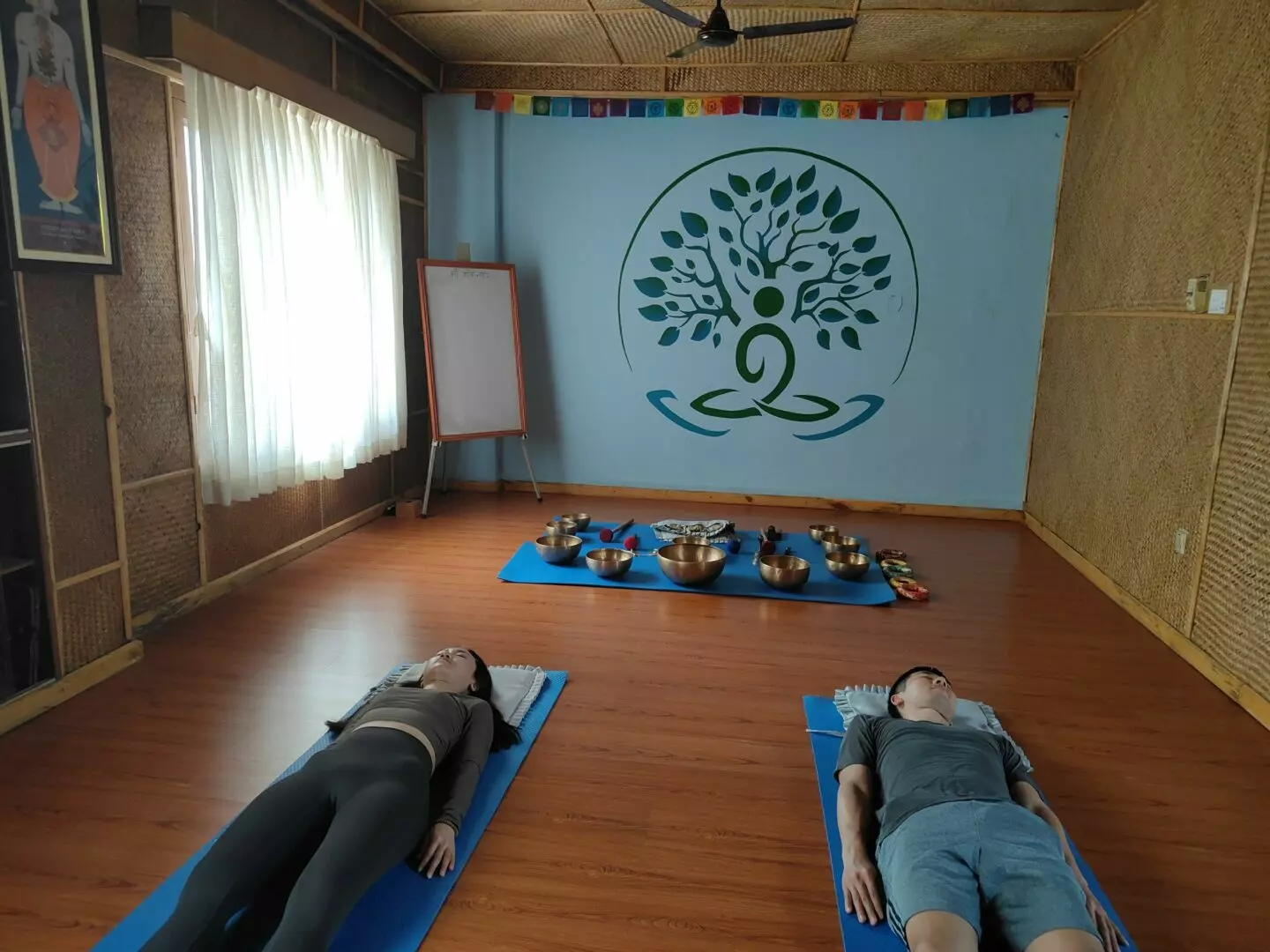
On both of our yoga treks the evening session runs from 5 to 6 p.m., before dinner. It changes through the week: mantra chanting, guided meditation, a talk on yoga philosophy, and yoga nidra, a guided relaxation done lying down. After a day on the trail it asks nothing of your legs.
To do a short version on your own, lie down after your stretches and cover yourself with a warm layer. Spend five minutes letting each part of the body go heavy, from the feet up to the head. Finish with a few minutes of one of the slow practices from our pranayama guide for beginners.
Yoga at altitude: what to change
Above about 2,500 m the air is thinner, and the practice should get gentler as you climb. Poon Hill sits at 3,210 m, and the Upper View Point on the Mardi Himal trek is around 4,200 m.
- Keep it slow. Move and breathe gently, and skip fast flows and strong holds at the higher camps.
- Keep breathwork easy. Slow nasal breathing is fine. Leave out breath retention and forceful breathing such as kapalabhati until you are back at a lower altitude.
- Come up slowly. Rise from forward folds and from lying down in stages, so you do not feel light-headed.
- Stay warm. Practise in your layers. The upper camps on the Mardi Himal route are cold, especially early in the morning.
- Listen to your body. If you have a headache, nausea, dizziness or unusual tiredness, stop and tell your guide. Sessions on our treks are optional, and you can rest instead, especially at the higher camps.
How this fits into a Bodhidham yoga trek
Both treks take seven days, starting and finishing in Pokhara. A yoga and meditation instructor walks with the group the whole way, and sessions are adapted to whoever is in the group, so beginners are welcome.
Mardi Himal Yoga Trek (up to about 4,200 m). On trekking days you wake at 5 a.m. for a classical yoga session, and there is a session at the Upper View Point after the early climb. It is graded moderate, with 3 to 5 hours of walking a day, some narrower ridge sections and cold upper camps. Choose it if you want a quieter trail and do not mind more altitude.
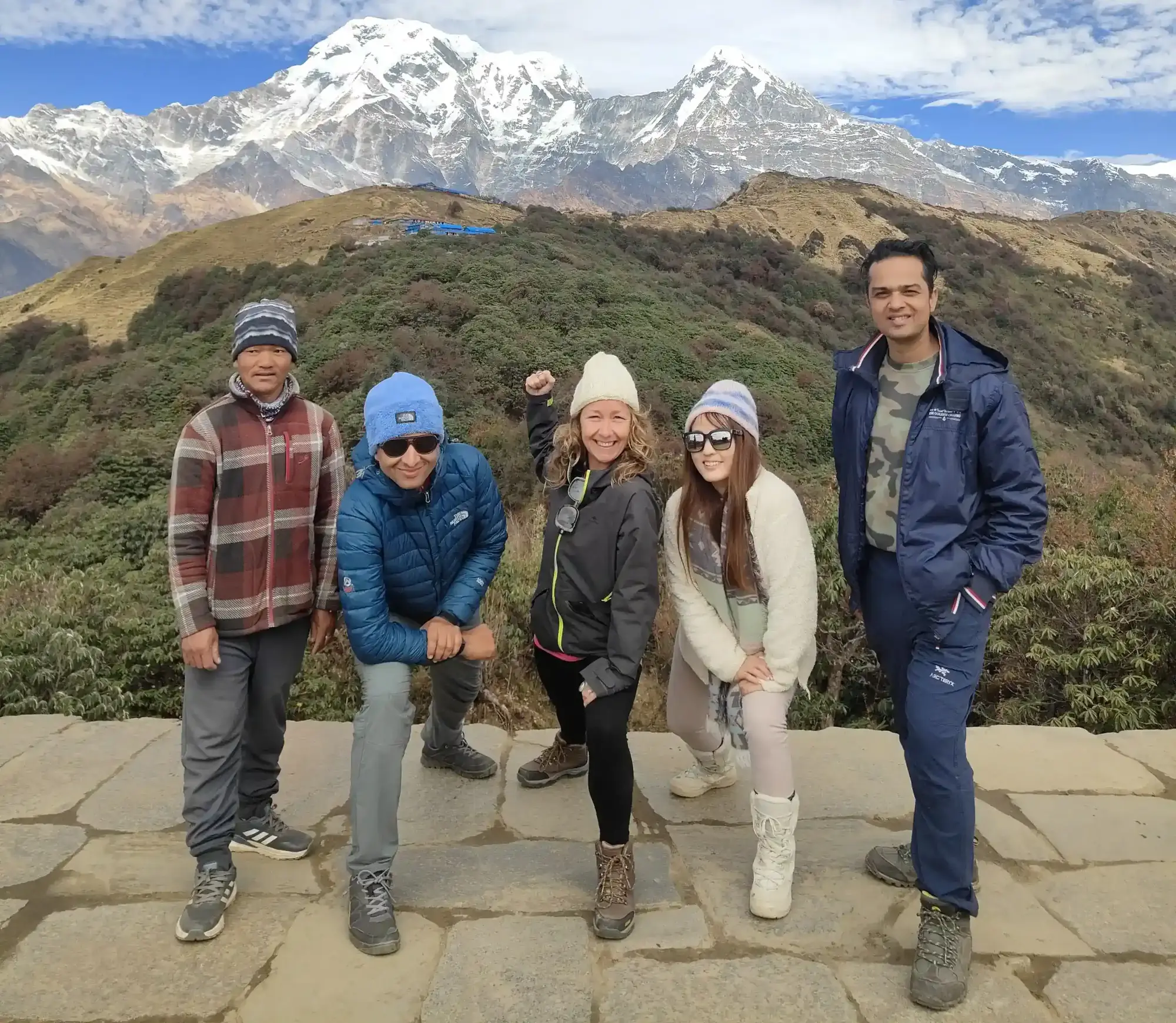
Poon Hill Yoga Trek (up to 3,210 m). Morning yoga runs from 6:30 to 7:30 a.m., with a session at Poon Hill after the sunrise hike. It is graded moderate, with 4 to 6 hours of walking on most days, including the stone steps up to Ulleri, and an hour in the hot springs at Jhinu Danda near the end. It makes a good first Himalayan trek.
Still deciding? Our guide to combining yoga and trekking covers fitness, packing and the best seasons, and the reasons to choose a Poon Hill yoga trek go deeper on the gentler route.
Frequently asked questions
Should I stretch before or after hiking?
Both, in different ways. Before a hike, keep it short and moving: a few minutes of gentle poses to warm up. After a hike, when your muscles are warm, hold longer stretches for 5 to 10 breaths each.
Do I need a yoga mat for yoga on a trek?
No. Most of the warm-up is done standing. For the floor poses after the hike, a folded jacket, a sleeping mat or a patch of flat grass is enough.
Can yoga help with sore legs after hiking?
Gentle stretching and legs up the wall can ease the stiffness after a long day. They do not replace rest, water and food. If a pain is sharp, sits in a joint such as the knee, or lasts more than a few days, see a doctor or physiotherapist.
Is yoga good preparation for a Himalayan trek?
It helps with balance, mobility and breathing, and walking is still the best preparation. In the weeks before a trek, take regular walks with some hills and a light pack, and add these poses on the days you walk.